Category: CONVENTION RIGHTS
21 November 2013 by Rosalind English
 R (on the application of London Christian Radio Ltd & Christian Communications Partnerships) v Radio Advertising Clearance Centre (Respondent) & Secretary of State for Culture, Media and Sport (Interested Party) [2013] EWCA Civ 1495 – read judgment
The ban on Christian Radio’s proposed advert seeking data on the “marginalisation of Christians” in the workplace was lawful and did not constitute an interference with free speech, the Court of Appeal has ruled. When determining whether a radio or television advertisement was “political” fur the purposes of Section 321(2)(b) of the Communications Act 2003 the court should consider the text objectively; the motives of the advertiser were irrelevant.
This was an appeal against a ruling by Silber J ([2013] EWHC 1043 (Admin)) that a proposed radio advertisement was directed towards a political end, and therefore fell foul of the prohibition on political advertising which meant that it could not be given clearance for broadcast (see my previous post on this decision).
Continue reading →
Like this:
Like Loading...
21 November 2013 by Guest Contributor
 Updated | The relationship between the UK and the European Court remains turbulent and fractious. The Court has been the subject of significant criticism, notably from some politicians and commentators in the UK, relating to its supposed interference in domestic, sovereign questions and the quality of its judges.
Some commentators say that the UK may have to withdraw from the jurisdiction of the court. Michael Pinto-Duschinsky argues that if (as is highly likely) the Council of Europe refuses to institute a “democratic override” for states of European Court of Human Rights decisions, withdrawal should be seriously considered. MP Nick Herbert argues that the UK should withdraw immediately.
Others have proposed withdrawing from the European Convention altogether. For example, in April, the Home Secretary, Theresa May, said that temporary withdrawal from the Convention was one option being considered by the UK government in its efforts to deport the Islamic cleric Omar Mohammed Othman (also known as Abu Qatada). Two members of the Commission tasked with investigating the creation of a UK Bill of Rights advocated withdrawal from the Convention unless the Court ceased its ‘judicially activist approach’ (p. 182).
Continue reading →
Like this:
Like Loading...
3 November 2013 by Kate Beattie
 Aintree University Hospitals NHS Foundation Trust (Respondent) v James (Appellant) [2013] UKSC 67 – Read judgment / press summary
The Supreme Court has given judgment in the first case to come before it under the Mental Capacity Act 2005. The sole judgment was given by Lady Hale (Deputy President of the Court), with whom Lord Neuberger, Lord Clarke, Lord Carnwath and Lord Hughes.
The case concerned best interests decisions in the case of a patient lacking capacity. The patient, David James, had been admitted to hospital in May 2012 aged around 68 because of a problem with a stoma he had had fitted in 2001 during successful treatment for cancer of the colon. The problem was soon solved but he acquired an infection which was complicated by the development of chronic obstructive pulmonary disease, an acute kidney injury and persistent low blood pressure. He was admitted to the critical care unit and placed on a ventilator.
Continue reading →
Like this:
Like Loading...
1 November 2013 by David Hart KC
 More naturism and the law, in the light of Mr Gough’s travails: see my post of yesterday.
For many years, the beautiful beach upon which Ms Paltrow was seen in Shakespeare in Love (my pic) has been a haven for naturists, even on the chilliest of days when the wind whips in from the north-east. However, things have changed this year. Initially, naturism was banned from the beach completely. The ban has now been lifted for the area of sand below the mean high water mark, but remains in place for the sand dunes.
How so?
Continue reading →
Like this:
Like Loading...
31 October 2013 by David Hart KC
 Gough v. Director of Public Prosecution [2013] EWHC 3267 – read judgment
Mr Gough wishes to walk up and down the UK naked. Others do not approve of this, so his progress has been somewhat stop-start. This appeal concerns a brief and inglorious autumnal outing in Halifax. He was released from the local nick at 11.30 am on 25 October 2012, wearing only walking boots, socks, a hat, a rucksack and a compass on a lanyard around his neck. “He was otherwise naked and his genitalia were on plain view.” He then walked through Halifax town centre for about 15 minutes.
In the words of the judgment, he received a “mixed reaction” from its inhabitants. At least one female member of the public veered out of his way. Evidence from two women was to the effect that they were “alarmed and distressed” and “disgusted” at seeing him naked. One of the women was with a number of children at least one of whom, 12 years old, she reported as “shocked and disgusted”. The district judge found that it caused one of the women to feel at risk, and, further, based on the evidence, that it caused alarm or distress.
Continue reading →
Like this:
Like Loading...
31 October 2013 by Adam Wagner

Stefan Rousseau/PA Wire
TV cameras are recording Court of Appeal hearings from today. The BBC, ITN, Sky News and the Press Association are cooperating on the project, and have hired an in-court video-journalist who will recommend the most interesting cases.
This is great news. Let in the light. The more that the public can see what is going on in their courts, the better. The courts are a bewildering place for the uninitiated and especially for those who cannot afford to pay someone to explain what is going on. This is still a relatively small advance – only appeals will be broadcast, not trials, so the public is unlikely to see any cross examination of witnesses. But hopefully it will be enough to increase public understanding of and interest in the courts.
But a word of warning. This initiative will only succeed if it is implemented in the right way. And, there are important lessons here from the Supreme Court’s ongoing broadcasting experiment.
Continue reading →
Like this:
Like Loading...
31 October 2013 by

A somewhat curious additional point arises out of the case of R (Antoniou) – see my earlier post for the main issue – in which the court decided that Article 2 ECHR does not require an independent investigation into deaths in state detention prior to a coroner’s inquest. There was therefore no obligation to ensure that there was an independent investigation into the suicide, or death resulting from self-harm, of a mentally ill person detained under Section 3 of the Mental Health Act 1983. There is such an investigation when a prisoner commits suicide. The Claimant thought this smacked of discrimination against the mentally disabled. The Court disagreed – on the somewhat surprising ground that you can’t be disabled once you’re dead.
Where a prisoner commits suicide, or dies as a result of self-harm, there will be an independent investigation from the outset. Any death in prison or in probation custody is automatically referred immediately to the Prisons and Probation Ombudsman for independent investigation. The Independent Police Complaints Commission performs a similar role for deaths in police, immigration or Customs & Excise detention. There is no equivalent independent investigator of deaths in mental health detention, which are investigated by the hospital where they occurred. The Claimant said this distinction discriminates between people who are mentally disabled and those of sound mind.
Continue reading →
Like this:
Like Loading...
30 October 2013 by Adam Wagner
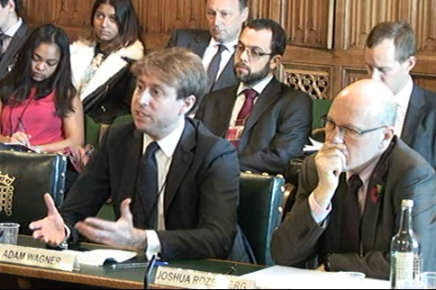 This morning Joshua Rozenberg and I gave evidence the Joint Select Committee on the Draft Voting Eligibility (Prisoners) Bill. You can watch our evidence session here – we are on from 10:34:30.
It was an interesting experience. There is clearly a range of views on the committee, to say the least. It will be fascinating to see what happens next – it is already almost a year since the draft bill was published and, as Joshua Rozenberg said, it seems quite possible that this issue will not be resolved one way or the other before the 2015 General Election, which is only 18 months away.
Continue reading →
Like this:
Like Loading...
29 October 2013 by Dominic Ruck Keene
 Janowiec and Others v Russia (Applications nos. 55508/07 and 29520/09) – read judgment
The European Court of Human Rights (ECtHR) has held that it had no competence to examine complaints relating to the adequacy of Russia’s criminal investigation into events that had occurred prior to the adoption of the European Convention on Human Rights (ECHR) in 1950: namely the Katyń Massacre of 1940.
The applicants were relations of 12 victims of the Katyń Massacre. They had been executed by the NKVD together with over 20,000 other former Polish Army officers, government officials, and landowners. A criminal investigation into the deaths ran from 1990 until 2004 when the Chief Military Prosecutor decided to discontinue ‘Criminal Case no. 159’ on the grounds that any alleged suspects were dead.
Continue reading →
Like this:
Like Loading...
28 October 2013 by Kate Beattie

Winterbourne View
Human rights protection for residents in private care homes could be a step closer after the House of Lords passed an amendment to the Care Bill.
The amendment, moved by Lord Low of Dalston and supported by Lord Lester of Herne Hill QC and Lord Pannick QC, makes clear that a person who provides regulated “social care” is to be taken for the purposes of subsection 6(3)(b) of the Human Rights Act 1998 to be exercising a function of a public nature.
It is the latest development in a long-running battle to secure human rights protection for service users who are not in local authority-run care homes.
Continue reading →
Like this:
Like Loading...
27 October 2013 by Adam Wagner
 Yesterday saw another poor piece of human rights reporting from the Telegraph, again from Home Affairs Correspondent David Barrett. Strasbourg human rights court threatens key counter-terrorism powers. It is a typical piece of hall-of-mirrors reporting; all of the basic elements are there but presented in a distorted and inaccurate way.
The piece is about the case of Sabure Malik, a British investment banker who was stopped by police in 2010 at Heathrow on his way back from an organised package tour to undertake the Hajj. Full details of his case, which is supported by Liberty, are in the Euoprean Court of Human Rights’ admissibility decision here. It was granted permission to proceed in May 2013, well before the David Miranda controversy which took place in August.
I’ll take this shortly.
Continue reading →
Like this:
Like Loading...
25 October 2013 by David Hart KC
 Lanner Parish Council (R ota) v. the Cornwall Council [2013] EWCA Civ 1290 read judgment
This planning judicial review tackles the problem posed by an authority who says one thing in its formal reasons granting planning permission, and another thing in the court proceedings when the grant is challenged.
Coastline wanted to construct 25 affordable dwellings in Lanner. The Parish in Lanner objected, on the basis that 25 was too many. It referred to a local planning policy (H20) which said that there should be no more than “about 12” houses on any new development in a large village such as Lanner.
The planning officer supported the grant of planning permission, and the Council agreed. The Council’s reasons for grant said that the proposal “accords with” policy H20. But it didn’t, because the policy referred to 12 houses, and the proposal was for 25 houses, and this error in the reasons was one of the Parish’s main points on the judicial review.
Continue reading →
Like this:
Like Loading...
23 October 2013 by David Hart KC
 The Plantagenet Alliance Ltd (R o.t.a) v. Secretary of State for Justice and others, Haddon-Cave J, 18 October 2013 (PCO) read judgment, and on permission, 15 August 2013 read judgment
I posted here on the original judgment giving the Plantagenet Alliance permission to seek judicial review of the Secretary of State’s decision to re-bury Richard III in Leicester. At the time, the judge had made a full Protective Costs Order in favour of the Alliance, so that it would not have to pay costs if it lost. The judge had also ordered what he envisaged to be a short hearing to determine in what sum the Alliance’s costs should be capped. if it won.
The judge was then somewhat surprised to be faced by a full-blown attempt by MoJ (Chris Grayling) to discharge the PCO, and seek an order for security of costs against the Alliance. The written argument in support was signed by the top barrister doing work for the Government, and the hearing about it took a day (think of the costs of that).
The application was conspicuously unsuccessful, as we shall see, but what was all this about? Something to do with proposed judicial review changes, I suspect – for reasons which will become evident.
Continue reading →
Like this:
Like Loading...
22 October 2013 by
R (Antoniou) v (1) Central and North West London NHS Foundation Trust; (2) Secretary of State for Health; (3) NHS England [2013] EWHC 3055 (Admin) – read judgment
Where a patient, detained in hospital under Section 3 of the Mental Health Act 1983, takes their own life, Article 2 imposes procedural obligations on the State to investigate the circumstances of the death. These obligations are fulfilled by a coroner’s inquest. Unlike in prison and police station deaths, there need not be any independent investigation system prior to the inquest stage, and nor does Article 2 require one.
Continue reading →
Like this:
Like Loading...
20 October 2013 by Guest Contributor
 At first glance, prisoner voting proponents may interpret the Supreme Court’s R (Chester) v Justice Secretary decision (see Adam Wagner’s previous post) as a defeat for advancing prisoner voting rights in the UK. This blog post offers a different perspective. By comparing Chester to the seminal US Supreme Court case of Marbury v. Madison, we summarise that such proponents should take a step back and see the wood, rather than merely the trees. This is because Lord Mance’s Chester judgment offers human rights advocates, and therefore supporters of prisoner voting rights, an unequivocal foundation from which to defend future human rights claims.
Chester does not achieve the same ends as Marbury. Marbury established the institution of judicial review in the United States, against Congressional legislation. Chester does not disturb the supremacy of the UK Parliament. Comparison arises within the strategies of the leading judgments in each case. Chief Justice Marshall’s judgment in Marbury is celebrated not only for its conclusion, that the Constitution of the United States is the highest form of law and therefore “it is emphatically the province and duty of the judicial department to say what the law is”, but also for how it reached that conclusion.
Continue reading →
Like this:
Like Loading...

 R (on the application of London Christian Radio Ltd & Christian Communications Partnerships) v Radio Advertising Clearance Centre (Respondent) & Secretary of State for Culture, Media and Sport (Interested Party) [2013] EWCA Civ 1495 – read judgment


Recent comments