8 November 2013 by David Hart KC
 Trust Special Administrator appointed to South London Healthcare NHS Trust v. LB Lewisham & Save Lewisham Hospital Campaign [2013] EWCA Civ 1409, 8 November 2013 – read judgment
Jeremy Hyam of 1 Crown Office Row acted for Save Lewisham Hospital Campaign. He was not involved in the writing of this post.
It takes a bit of time to close a hospital or make major changes to it. This is because you must go through a complicated set of consultations with all those likely to be affected before action can be taken. Many, if not most, people say this is a good thing, and Parliament has embedded these duties of consultation in the law.
In this case, the Department of Health said it could close the A&E Department of Lewisham Hospital, as well as limiting maternity services to midwives alone and reducing paediatric services – without going through the formal consultation process. The Borough of Lewisham, and a local campaigning group, said that the DoH had no power in law to do this.
The judge, Silber J, agreed with them, and so now does the Court of Appeal. It dismissed Jeremy Hunt’s appeal 10 days ago, and published its reasons today.
If Mr Grayling has his way, it seems unlikely that the Save Lewisham Hospital Campaign would have had “standing” to bring this claim, however meritorious in law it may have been: see my post on this. I dare say this lesson will not be lost on him, though, sadly, many think that such wins against the government make it more rather than less likely that he will implement his changes to the rules in judicial review.
Continue reading →
Like this:
Like Loading...
7 November 2013 by Rosalind English
 CF v Security Service and others and Mohamed v Foreign and Commonwealth Office and others [[2013] EWHC 3402 (QB) – read judgment
The High Court has today made the first court ruling on the use of the Justice and Security Act 2013 in a civil claim for damages.
In a ruling on preliminary issues, Irwin J made a declaration that the government can make a closed material application to the court in this case. The Court also ruled on PII. The following summary is based on the Court’s press release.
Factual background
CF and Mohammed Ahmed Mohamed are both British citizens of Somali descent. CF left the United Kingdom in 2009, Mohammed Ahmed Mohamed having left in 2007. They were both detained by the Somaliland Authorities on 14 January 2011. They were then detained until removal to the UK on 14 March 2011. Each claims that they were unlawfully detained, tortured and mistreated during the period of detention in Somaliland.
Continue reading →
Like this:
Like Loading...
6 November 2013 by Rosalind English
 AJA and others v Commissioner of Police for the Metropolis [2013] EWCA Civ 1342 – read judgment
The words “personal or other relationship” in the section 26(8)(a) Regulation of Investigatory Powers Act 2000 included intimate sexual relationships so that the Investigatory Powers Tribunal had jurisdiction to hear the appellants’ claims that their human rights had been violated by undercover police officers who had allegedly had sexual relationships with them
There were two groups of claimants in this case. The first three were represented by Birnberg Pierce & Partners (referred to as “the Birnberg claimants”). The second three were represented by Tuckers (referred to as “the Tuckers claimants”). Both groups alleged that they had suffered violations of their rights under Articles 3 and 5 by the officers for whom the respondents were responsible and that such conduct was contrary to the Human Rights Act 1998 s.6(1). They appealed against a decision that the Investigatory Powers Tribunal had jurisdiction to decide their human rights claims and that High Court proceedings should be stayed pending the IPT’s determination.
Continue reading →
Like this:
Like Loading...
6 November 2013 by Guest Contributor
 R (on the application of Ingenious Media Holdings plc and Patrick McKenna v Her Majesty’s Revenue and Customs [2013] EWHC 3258 (Admin) – read judgment
Sales J has rejected an application for judicial review by Ingenious Media Holdings plc and Patrick McKenna, who complained that senior officials in HMRC had identified them in “off the record” briefings.
Ingenious Media is an investment and advisory group which promotes film investment schemes which allow participators to take advantage of certain tax reliefs and exemptions. HMRC has long been fighting to close down these “film schemes”, with some success (see the Eclipse 35 appeal).
Continue reading →
Like this:
Like Loading...
5 November 2013 by Guest Contributor
 Re J (A Child) ([2013] EWHC 2694 (Fam) – read judgment
In this case the President of the Family Division, Sir James Munby, considered an application for a contra mundum injunction by Staffordshire County Council. He emphasised that the only proper purpose of such an injunction was to protect the child and refused to make an order in the wide terms sought by the Council. As a result, he allowed the publication of video footage and photographs of a baby being removed from its parents.
Continue reading →
Like this:
Like Loading...
4 November 2013 by Daniel Isenberg
 Welcome back to the UK Human Rights Roundup, your regular great bright firework display of human rights news and views. The full list of links can be found here. You can find previous roundups here. Post by Daniel Isenberg, edited and links compiled by Adam Wagner.
Some crucial judgments were handed down this week in the sphere of judicial review, with mixed results for the government. Elsewhere discussions continued about the future of human rights under a Tory government in 2015, as well as religious rights within the family courts. Keep an eye out for the upcoming Grand Chamber hearing on the full-face veil, as well as the open government consultation on the Balance of Competences Fundamental Rights Review.
Continue reading →
Like this:
Like Loading...
3 November 2013 by Kate Beattie
 Aintree University Hospitals NHS Foundation Trust (Respondent) v James (Appellant) [2013] UKSC 67 – Read judgment / press summary
The Supreme Court has given judgment in the first case to come before it under the Mental Capacity Act 2005. The sole judgment was given by Lady Hale (Deputy President of the Court), with whom Lord Neuberger, Lord Clarke, Lord Carnwath and Lord Hughes.
The case concerned best interests decisions in the case of a patient lacking capacity. The patient, David James, had been admitted to hospital in May 2012 aged around 68 because of a problem with a stoma he had had fitted in 2001 during successful treatment for cancer of the colon. The problem was soon solved but he acquired an infection which was complicated by the development of chronic obstructive pulmonary disease, an acute kidney injury and persistent low blood pressure. He was admitted to the critical care unit and placed on a ventilator.
Continue reading →
Like this:
Like Loading...
1 November 2013 by Rosalind English
 Youssef v Secretary of State for Foreign and Commonwealth Affairs [2013] EWCA Civ 1302, 29 October 2013 – read judgment
There was nothing unlawful in the Foreign Secretary’s decision to allow a UK resident to be added to the UN’s Consolidated List of members of Al-Quaida and its associates .
This was an appeal against the Administrative Court’s dismissal of the appellant’s claim for judicial review of the secretary of state’s decision to allow him to be added to a list of persons subject to sanctions under UN Security Council Resolution 1617. This Resolution required UN member states to freeze the assets on those named on the Consolidated List of members of Al-Qaida and its associates. The relevant UN committee was asked to add the name of the appellant, an Egyptian national resident in the UK, to the list. The secretary of state placed a hold on the appellant’s designation so the UK could consider whether he met the criteria for designation. The Foreign Secretary subsequently accepted that he did meet the criteria and released the hold, which meant that he was added to the list. Once a designation is made, it lasts until all members of the Security Council can be persuaded that it should be lifted.
Continue reading →
Like this:
Like Loading...
1 November 2013 by David Hart KC
 More naturism and the law, in the light of Mr Gough’s travails: see my post of yesterday.
For many years, the beautiful beach upon which Ms Paltrow was seen in Shakespeare in Love (my pic) has been a haven for naturists, even on the chilliest of days when the wind whips in from the north-east. However, things have changed this year. Initially, naturism was banned from the beach completely. The ban has now been lifted for the area of sand below the mean high water mark, but remains in place for the sand dunes.
How so?
Continue reading →
Like this:
Like Loading...
31 October 2013 by Adam Wagner
 The Ministry of Justice is calling for evidence on the Review of the Balance of Competences between the United Kingdom and the European Union, specifically relating to fundamental rights. The consultation document is here and main website here.
The deadline for responses is 13 January 2014, but if you want to take part in one of the four discussion groups (three in London, one in Edinburgh), you need to email by tomorrow – all details below.
And don’t let the obscure-sounding title put you off. This review is potentially very important. Just look how broad question 1 is:
Continue reading →
Like this:
Like Loading...
31 October 2013 by David Hart KC
 Gough v. Director of Public Prosecution [2013] EWHC 3267 – read judgment
Mr Gough wishes to walk up and down the UK naked. Others do not approve of this, so his progress has been somewhat stop-start. This appeal concerns a brief and inglorious autumnal outing in Halifax. He was released from the local nick at 11.30 am on 25 October 2012, wearing only walking boots, socks, a hat, a rucksack and a compass on a lanyard around his neck. “He was otherwise naked and his genitalia were on plain view.” He then walked through Halifax town centre for about 15 minutes.
In the words of the judgment, he received a “mixed reaction” from its inhabitants. At least one female member of the public veered out of his way. Evidence from two women was to the effect that they were “alarmed and distressed” and “disgusted” at seeing him naked. One of the women was with a number of children at least one of whom, 12 years old, she reported as “shocked and disgusted”. The district judge found that it caused one of the women to feel at risk, and, further, based on the evidence, that it caused alarm or distress.
Continue reading →
Like this:
Like Loading...
31 October 2013 by Rosalind English
 This week’s newspapers have highlighted the plight of the thousands of British homeowners who face demolition orders over their Spanish properties because they have been built without proper planning permission. Permits granted by town mayors during the property boom turn out not to be worth the paper they were written on, and since the regional authorities have overturned most of these permits, the buildings are condemned to destruction. Compensation from the developers and public officials who made these transactions possible is not forthcoming; as the Times leader points out
In a few cases, the courts have ordered that developers or town halls should compensate those who have lost their homes. Yet the former invariably opt for bankruptcy, instead, and even the latter seem markedly reluctant to pay out. Owners, often now back in Britain, face daunting and bewildering battles in foreign courts. (Tuesday 29 October, behind paywall)
Now one couple, Terry and Christine Haycock, are testing how far the Strasbourg Court will go to protect their property rights in this fracas (which would be under Article 1 Protocol 1).
Continue reading →
Like this:
Like Loading...
31 October 2013 by Adam Wagner

Stefan Rousseau/PA Wire
TV cameras are recording Court of Appeal hearings from today. The BBC, ITN, Sky News and the Press Association are cooperating on the project, and have hired an in-court video-journalist who will recommend the most interesting cases.
This is great news. Let in the light. The more that the public can see what is going on in their courts, the better. The courts are a bewildering place for the uninitiated and especially for those who cannot afford to pay someone to explain what is going on. This is still a relatively small advance – only appeals will be broadcast, not trials, so the public is unlikely to see any cross examination of witnesses. But hopefully it will be enough to increase public understanding of and interest in the courts.
But a word of warning. This initiative will only succeed if it is implemented in the right way. And, there are important lessons here from the Supreme Court’s ongoing broadcasting experiment.
Continue reading →
Like this:
Like Loading...
31 October 2013 by

A somewhat curious additional point arises out of the case of R (Antoniou) – see my earlier post for the main issue – in which the court decided that Article 2 ECHR does not require an independent investigation into deaths in state detention prior to a coroner’s inquest. There was therefore no obligation to ensure that there was an independent investigation into the suicide, or death resulting from self-harm, of a mentally ill person detained under Section 3 of the Mental Health Act 1983. There is such an investigation when a prisoner commits suicide. The Claimant thought this smacked of discrimination against the mentally disabled. The Court disagreed – on the somewhat surprising ground that you can’t be disabled once you’re dead.
Where a prisoner commits suicide, or dies as a result of self-harm, there will be an independent investigation from the outset. Any death in prison or in probation custody is automatically referred immediately to the Prisons and Probation Ombudsman for independent investigation. The Independent Police Complaints Commission performs a similar role for deaths in police, immigration or Customs & Excise detention. There is no equivalent independent investigator of deaths in mental health detention, which are investigated by the hospital where they occurred. The Claimant said this distinction discriminates between people who are mentally disabled and those of sound mind.
Continue reading →
Like this:
Like Loading...
30 October 2013 by Adam Wagner
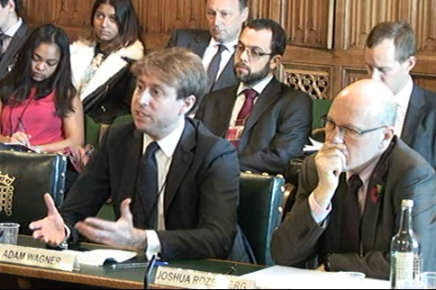 This morning Joshua Rozenberg and I gave evidence the Joint Select Committee on the Draft Voting Eligibility (Prisoners) Bill. You can watch our evidence session here – we are on from 10:34:30.
It was an interesting experience. There is clearly a range of views on the committee, to say the least. It will be fascinating to see what happens next – it is already almost a year since the draft bill was published and, as Joshua Rozenberg said, it seems quite possible that this issue will not be resolved one way or the other before the 2015 General Election, which is only 18 months away.
Continue reading →
Like this:
Like Loading...

 Trust Special Administrator appointed to South London Healthcare NHS Trust v. LB Lewisham & Save Lewisham Hospital Campaign [2013] EWCA Civ 1409, 8 November 2013 – read judgment


Recent comments