We use cookies to enhance your browsing experience. If you continue to use our website we will take this to mean that you agree to our use of cookies. If you want to find out more, please view our cookie policy. Accept and Hide [x]
UK Human Rights Blog - 1 Crown Office Row
Search Results for: environmental/page/16/Freedom of information - right of access) [2015] UKUT 159 (AAC) (30 March 2015)
The United Kingdom has been ordered by the European Court of Human Rights to pay damages and legal costs to a social worker who was unfairly accused of professional misconduct by a Family Court judge.
Facts
The applicant was a social worker who was called to give evidence in childcare proceedings concerning the alleged sexual abuse of a number of siblings.
The Family Court rejected the allegations of sexual abuse. The judge also found that the applicant was the principal instigator in a “joint enterprise to obtain evidence to prove the sexual abuse allegations, irrespective of the underlying truth and relevant professional guidelines”; that she had lied to the court about important aspects of the investigation; and that she had subjected one of the children involved to emotional abuse.
The applicant first became aware of these adverse findings at the end of the hearing when the judge gave a summary oral judgment. Prior to finalising the judgment, she was able to make some submissions, including in respect of the decision not to grant her anonymity. However, the adverse findings and the decision not to grant her anonymity were maintained. The judge also directed that the judgment be sent to the authority to which the applicant had since been re-assigned, and advised that his findings should be shared with other local authorities where she had worked and with the relevant professional bodies.
Her local authority assignment was then terminated without notice.
The local authority and the applicant sought to appeal against the Family Court judgment. Before the Court of Appeal, the case was argued as a procedural violation, namely that the highly adverse findings “came out of the blue” and had the potential to impact adversely on her employment prospects and personal life, yet she had not been given any opportunity to know of or meet the allegations during the course of the trial process. The Court of Appeal found that the criticism would breach her rights under Art. 8 of the Convention if the judgment were allowed to stand. The process by which the judge arrived at the criticisms was “manifestly unfair to a degree which wholly failed to meet the basic requirements of fairness established under Art.8.” His findings were set aside, in the sense that “they no longer stood and had no validity”. The effect was to be “as if those findings, or potential findings, had never been made in any form by the judge” (§§ 16 – 20).
As predicted on this Blog, the Supreme Court has made a declaration of incompatibility covering sections one and three of the Civil Partnership Act 2004 (to the extent that they preclude a different sex couple from entering into a civil partnership).
To an extent, this was not a surprise as, by the time the case reached the Supreme Court, the government had conceded that the current situation in which same sex couples have had a choice between marriage and civil partnership since 13th March 2014, whereas heterosexual couples only have the option of marriage, is discriminatory.
And so we come to the end of another year. The Covid-19 pandemic has continued to dominate the news, particularly with the very concerning surge of the Omicron variant this month. Many reading this will be separated from loved ones over Christmas. The year has also seen the return to power of the Taliban in Afghanistan after the US withdrawal at the end of August, the resumption of military rule in Myanmar and the ongoing persecution of the Uyghurs by the Chinese government, this year recognised by the House of Commons and the US government (as well as many other bodies and organisations) as constituting a genocide. So, one could say that this year has rivalled last year for infamy.
But what, I hear you ask, about the law? As always, this year has been packed with fascinating and important legal developments — many of which you may have caught, but some of which may have passed under the radar. And so, please refresh your glass (or mug) and join me on another adventure as we review the 10 cases that defined 2021.
On 5th December 2017, the Divisional Court gave judgment in Power v HM Senior Coroner for Inner London [2017] EWHC 3117 (Admin), directing that an inquest held in 1998 into a road traffic accident following a police chase had been insufficient and a fresh inquest needed to be held.
Justices: Lord Hodge, Lord Briggs, Lord Leggatt, Lord Burrows and Lady Simler
The Supreme Court has affirmed that there is no duty of care, and hence no liability in negligence, for failing to confer a benefit, which includes failing to protect a person from injury, as opposed to making matters worse. This applies equally to public authorities such as the police as it does to private individuals.
Brief Summary
On 4 March 2014, Mr Kendall’s car skidded on a patch of black ice on the A413 road, causing him to lose control and roll over into a ditch. Concerned by the state of the road, after making an emergency call, he stood by the road signalling cars to slow down.
Around 20 minutes later, police officers attended the scene. They started clearing up debris from the accident and put up a “Police Slow” sign up. After warning the police about the dangerous state of the road, Mr Kendall left to visit the hospital to tend for non-life-threatening injuries he had suffered. It was alleged that, but for the arrival of the police, Mr Kendall would have continued attempts to alert road users of the danger. Having cleared the debris, and after Mr Kendall had gone to hospital, the police officers removed the “Police Slow” sign and left the scene, with the road in the same condition as it had been previously. They did so in the belief that there was no hazard and having failed to discover or inspect the sheet ice.
Michael and others (Appellants) v The Chief Constable of South Wales Police and another (Respondents) [2015] UKSC 2 – read judgment
Duncan Fairgrieve of 1 Crown Office Row was part of the team of counsel representing the appellants in this case. He has had nothing to do with the writing of this post.
The Supreme Court has rejected a challenge to the long-standing rule that the police owe no duty of care in negligence in the context of protecting victims from potential future crimes.
Background
The background facts to the case are shocking. On 5 August 2009, at 2.29am, Ms Michael dialled 999 from her mobile phone. She told the call handler at the Gwent Police call centre that her ex-boyfriend was aggressive; he had just turned up at her house; he had found her with another man; he had bitten her ear really hard; he then drove the other man home with Ms Michael’s car but, before doing so, told her that he would return to hit her; that he was going to be back “any minute literally” and, according to the recorded transcript of the conversation, that her ex-boyfriend had told her “I’m going to drop him home and (inaudible) [fucking kill you]”. Continue reading →
Conor Monighan brings us the latest updates in human rights law
In the News:
The CPS has said there is enough evidence to charge two Russian men with conspiracy to murder Sergei and Yulia Skripal. Although the Skripals survived, another lady called Dawn Sturgess later died of exposure to Novichok.
The two men visited Salisbury last March, at the same time the nerve agent attack took place. It is believed the two men, Alexander Petrov and Ruslan Boshirov, are military intelligence officers for GRU, the Russian security service. The CPS has not applied for their extradition because of Russia’s longstanding policy that it does not extradite its own nationals. A European Arrest Warrant has been obtained in case they travel to the EU.
In response, the two men have claimed they were merely tourists. In an appearance on Russia Today (RT), they said the purpose of their visit to Salisbury was to see its cathedral. Arguing that their presence was entirely innocent, the two men said they were following recommendations of friends. Petrov and Boshirov went on to say that, whilst they had wanted to see Stonehenge, they couldn’t because of “there was muddy slush everywhere”. The men insisted they were businessmen and that, whilst they might have been seen on the same street as the Skripals’ house, they did not know the ex-spy lived there. The Russian President, Vladimir Putin, has said they are “civilians” and that “there is nothing criminal about them”. Continue reading →
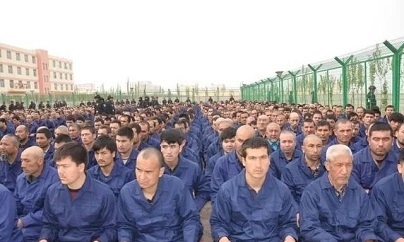
For several years, China has been enacting a policy of repression and brainwashing against over a million Uyghur Muslims in its northwest Xinjiang province. Reports include instances of forced sterilisation. Its hundreds of ‘re-education’ camps have been revealed as places where contact with relatives, the ability to pray and even when to use the toilet are tightly controlled. A leaked document reveals the state’s use of algorithms to score inmates on a ‘behaviour-modification’ points system, which tells guards when to mete out rewards and punishments. Absent from their homes, Uyghur places of worship are secretly bulldozed en masse.
On Tuesday, the UK government announced new rules that seek to prevent UK companies profiting from forced Uyghur labour. Companies will have to demonstrate that their supply chains are free from slavery. Public procurement rules will also attempt to exclude suppliers with links to human rights violations. This new policy appears to implement Key Proposal no. 5 of the newly created China Research Group, a think tank set up by Tory MPs to ‘counter violations of international universal human rights’. The ERG-style group was formed after China’s coronavirus cover-up operation became clear.
“The question is,” said Alice, “whether you can make words mean so many different things.”
“The question is,” said Humpty Dumpty, “which is to be master – that’s all.”
Through the Looking Glass, Chapter 6
Few judicial decisions provoke the frenzy of editorials, newspaper articles, opinion pieces, facebook status updates and dinner table debates as were prompted by that of the Employment Tribunal last Friday in Aslam, Farrar and Others v Uber. Fewer still can boast references to both Shakespeare and Milton, nor deliver such a joy to read (assuming you are not, in fact, the Respondents’ lawyers). Volunteering to write about the judgment shortly after its publication on Friday afternoon, it took little time before I realised this piece would be one among a crowded chorus of views.
Among the maelstrom, The Sunday Times (£) was concerned it would herald the end of the end of the ‘gig’ economy, the Guardian argued that avoiding paying benefits was not a fair route to profits, while the Financial Times (£) approved the forging of a ‘middle way’ for fair treatment of workers and the company. For some the decision was seismic, potentially ground-breaking; for others it could spell tragedy; a lone voice thought it would change very little. Rightsinfo have provided an excellent plain English summary here.
Mr Finucane, a Belfast solicitor who had represented a number of high profile IRA and INLA members including Bobby Sands, was murdered in front of his family by loyalist paramilitaries in one of the most notorious killings of the Troubles. His death was mired in controversy due to the collusion between the security forces and his killers. Mr Justice Stephens stated at the outset of his judgment that
It is hard to express in forceful enough terms the appropriate response to the murder, the collusion associated with it, the failure to prevent the murder and the obstruction of some of the investigations into it. Individually and collectively they were abominations which amounted to the most conspicuously bad, glaring and flagrant breach of the obligation of the state to protect the life of its citizen and to ensure the rule of law. There is and can be no attempt at justification.
Happy international women’s week, Human Rights Blog readers! Women’s rights are human rights and human rights matter, so to help you keep fighting the good fight we’ve curated the week’s legal updates for your immediate consumption.
The Supreme Court has heard the issue of whether a male employee in a civil partnership is entitled to the same pension for his spouse as if he were married to a woman (Walker v Innospec, UKSC 2016/0090).
Our friends over at Rights Info have curated some landmark cases for women’s equality, and you can read up on them here.
Attorney General v Associated Newspapers Ltd & Anor [2011] EWHC 1894 (Admin) – Read judgment
The High Court has handed down fines of £15,000 each and to Associated Newspapers and News Group Newspapers (NGN), owners of The Daily Mail and The Sun, for contempt of court. The companies will also have to pay £28,117.23 to cover the Attorney General’s costs. This blog’s co-editor Angus McCullough QC appeared for the Attorney General in the case but is not the writer of this post.
The newspapers’ owners, particularly NGN, probably have other things on their minds at the moment. But the fines, which relate to contempt proceedings decided in March (read judgment / my post) represent something of a landmark, as they are the first relating to online publication. In this case, The Sun Online and Mail Online published pictures of Ryan Ward holding a gun whilst he was on trial for murder.
Malik v United Kingdom 23780/08 [2012] ECHR 438 (13 March 2012) – Read judgment
The European Court of Human Rights held that the suspension of a GP from the Primary Care Trust (PCT) Performers List did not violate his right to peaceful enjoyment of possessions under Article 1 Protocol 1 (A1P1) of the European Convention on Human Rights. The Court declined to decide whether there was a possession that could be interfered with in this case, but held that suspension did not affect Dr Malik.
Dr Malik ran a general practice from premises he owned in London. He was under a general medical services contract with his PCT so that he had to ensure patients on his list were provided with GP services (whether by himself or a salaried doctor); his premises was rented (for a notional amount) so that it could be used for NHS services. Dr Malik was also on the PCT’s performers list so that he personally could provide GP services.
This afternoon, health secretary Matt Hancock made a statement in the Commons updating the house on the government’s response to the crisis.
The health secretary announced that anyone in the UK aged five and over who has coronavirus symptoms will be eligible for a test. From today, recognised symptoms include the loss of smell and taste, as well a persistent cough and a high temperature. Hancock confirmed for the first time that the government has recruited over 21,000 contact tracers, including 7,500 health care professionals, to manually trace and get in contact with anyone who has tested positive.
In addition, he offered a degree of clarification in relation to the government’s new contact tracing app. The function of the app is to alert people of the need to self-isolate if they have come into proximity with an individual who reported coronavirus symptoms.
The Prime Minister announces the lockdown on 23rd March. Image: The Guardian
Emmet Coldrick is a barrister at Quadrant Chambers, London. The opinions expressed in this article are the personal opinions of its author. Legal scrutiny of the provisions discussed in this piece is warranted but should not be taken to question the requirement to obey the regulations.
The first article in this two-part analysis examined whether the Health Protection (Coronavirus, Restrictions) (England) Regulations 2020 fall within the Minister’s powers under section 45C(4)(d) of the Public Health (Control of Disease) Act 1984 to impose “a special restriction or requirement”.It can be found here.
This second article will discuss the proper approach that the court should take where fundamental rights are in issue and argue that the Regulations were in fact ultra vires.
This is the second part of a blog post on this topic. The first part concluded part-way through a discussion of whether the Regulations fall within the Minister’s powers under section 45C(4)(d) of the Public Health (Control of Disease) Act 1984 to impose “a special restriction or requirement”.
Proper approach to interpretation where fundamental rights are in issue
A troubling feature of the section of the judgment in Dolan that deals with the ultra vires issue is that it makes no reference to the gravity of the restrictions on liberty imposed by the Regulations or of the fact that, on the Secretary of State’s case, the Act confers powers to impose still graver restrictions on fundamental rights. Instead, the judgment refers blandly at paragraph 43 to “the adoption of a range of measures”.
It is also regrettable that, while glossing over of the seriousness of the interference with fundamental rights that would be permitted if his interpretation of the Act were correct, the Secretary of State stressed the “threat”, submitting that “… it would be absurd if the provisions were to be read otherwise given the nature of the public health threat …” (judgment para. 36). That approach to the question of the scope of the Secretary of State’s powers is redolent of the kind reasoning that characterises justifications of rule by diktat and is the antithesis of the rule of law. A decree that no one may leave her home without reasonable excuse, or gather with more than one other person in a public place, is the sort of restriction that might be imposed by a totalitarian regime or an invading foreign power.
It is welcome that in his Reasons for granting permission to appeal, Hickinbottom LJ noted that “… not only did/do the challenged Regulations impose possibly the most restrictive regime on the public life of persons and businesses ever – certainly outside times of war – but they potentially raise fundamental issues concerning the proper spheres of democratically-accountable Ministers of the Government and judges”.
This blog is maintained for information purposes only. It is not intended to be a source of legal advice and must not be relied upon as such. Blog posts reflect the views and opinions of their individual authors, not of chambers as a whole.
Our privacy policy can be found on our ‘subscribe’ page or by clicking here.


 As predicted on this

 On 5th December 2017, the Divisional Court gave judgment in




.jpg/320px-Women%27s_March_on_Washington_(32593123745).jpg)

 Attorney General v Associated Newspapers Ltd & Anor [2011] EWHC 1894 (Admin) –
 Malik v United Kingdom 23780/08 [2012] ECHR 438 (13 March 2012) –


Recent comments