Search Results for: bill of rights/page/69/HTML
28 September 2014 by Celia Rooney
 Welcome back to the UK Human Rights Roundup, your regular party gathering of human rights news and views. The full list of links can be found here. You can find previous roundups here. Links compiled by Adam Wagner, post by Celia Rooney.
This week, the Conservative Party will unveil its plans for human rights reform in the UK. In other news, Chris Grayling’s decision to drastically reduce the number of legal aid contacts granted is successfully challenged, while a prosecution for assisted suicide keeps the assisted dying debate alive.
Tories Unveil Plans for Human Rights Reform
Continue reading →
Like this:
Like Loading...
8 November 2013 by Rosalind English
 AB, R (on the application of) v Secretary of State for the Home Department [2013] EWHC 3453 (Admin) – read judgment
Here unfolds a story of sophisticated abuse of the asylum system in this country by an individual skilfully shamming persecution. Nor did the security agents who escorted the claimant on his departure come up smelling of roses: it emerged during the course of these proceedings that they had falsified a room clearance certificate to boost the defence case.
The judgment also points up the potentially far-reaching effect of the Charter of Fundamental Rights of the European Union and how this might render all the handwringing about the European Convention on Human Rights irrelevant, and a home grown Bill of Rights otiose.
Factual background
The claimant, whom Mostyn J describes as “a highly intelligent, manipulative, unscrupulous and deceitful person”, arrived in this country in 2005, was refused asylum and was deported in 2010. He sought judicial review of the Home Secretary’s decision to refuse his claim and return him to his state of embarkation, “Country A” (so designated because there was a reporting restriction order made in the original proceedings anonymising both the claimant, his country of origin, and the political organisation of which he claimed to be a member. Mostyn J “reluctantly” went along with that order in this proceedings, since neither of the parties applied to have it reviewed.)
Continue reading →
Like this:
Like Loading...
14 April 2011 by Catriona Murdoch

As we posted earlier this week, US State department has released its 35th annual Country Reports on Human Rights Practices, including an in-depth analysis of human rights in the UK.
The report overall gives a balanced view of the Human Rights Practices in the UK, with some criticism but also some praise. It touches upon many of the issues reported in the UK Human Rights Blog but also misses some important topics that have emerged since the last annual country report.
Continue reading →
Like this:
Like Loading...
27 June 2011 by Adam Wagner
 Members of the UK Bill of Rights Commission, an independent body asked by the government to investigate the case for a UK Bill of Rights, has been giving evidence to the Political and Constitutional Reform Committee (transcripts here: part 1, part 2). The sessions give an interesting if predictable insight into the likely discussions between the Commission’s members.
The group has made slow progress so far, and little is known about how it will operate, save that any proposed bill must “incorporate.. and build.. on all our obligations under the European Convention on Human Rights“. It is under no great time pressure, having been asked to report by the end of 2012. It is comprised of 9 people, mostly Queen’s Counsel and not all of whom are human rights experts. It also has a website, which provides little information beyond the dates of meetings. Given the importance of the process and lack of information so far, the evidence sessions are of interest.
Continue reading →
Like this:
Like Loading...
10 December 2012 by Guest Contributor
 Today is Human Rights Day, marking the adoption of the Universal Declaration of Human Rights. Sanchita Hosali, from the British Institute of Human Rights, an independent charity working to bring rights to life beyond the statue books and courtrooms, reflects on our domestic human rights debates and those voices that are often missing from the conversation.
Last week saw 72 MPs vote in favour of a motion to repeal the Human Rights Act. So today, on Human Rights Day, 72 civil society groups have written to the Prime Minister and Deputy Prime Minister urging them to safeguard the Human Rights Act. As we await the report from the Commission on a UK Bill of Rights, what unites these 72 groups is concern and disappointment that “what should be a healthy debate about how best to secure the human rights of each and every one of us has, for far too long, lacked political leadership.” This “jeopardises the progress we have made at home in ensuring that our human rights obligations lead to real change for people in their everyday lives.”
Continue reading →
Like this:
Like Loading...
12 March 2012 by Sam Murrant
 Welcome back to the UK Human Rights Roundup, your weekly summary of human rights news. The full list of links can be found here. You can also find our table of human rights cases here and previous roundups here.
In the news
It’s been another big week for human rights, with the draft Brighton Declaration again sparking insightful discussion from a range of sources. Also in the news, concerns seem to be rising over open justice, with secret evidence, the Justice and Security Green Paper and access to court materials all raising concerns in the media. To round off the week, there’s the CPS’s new guidance on prosecution for criminal offences committed during public protests, a roundup of important cases to look out for in the upcoming weeks, and the mandatory (for myself, anyway) update on the Abu Qatada saga.
Continue reading →
Like this:
Like Loading...
8 April 2020 by Euan Lynch
Introduction
Serco is a private company that was contracted by the UK Home Office between 2012 and 2019 to provide accommodation to asylum seekers living in Glasgow. In July 2018, Serco began to implement the “move on protocol” – a new policy of changing locks and evicting asylum seekers without a court order if they were no longer eligible for asylum support. This put around 300 asylum seekers – who had no right to work or who had no right to homeless assistance – at risk of eviction and homelessness in Glasgow without any court process.
In response to this, the Stop Lock Change Evictions Coalition (“the Coalition”) was formed by various organisations, charities and lawyers who all united for one common purpose – to protect asylum seekers’ human rights, particularly in relation to housing.
Continue reading →Like this:
Like Loading...
14 October 2013 by Sarina Kidd
 Welcome back to the UK Human Rights Roundup, your regular full brass band of human rights news and views. The full list of links can be found here. You can find previous roundups here. Post by Sarina Kidd, edited and links compiled by Adam Wagner.
This week, Lord Neuberger implied that even if the Human Rights Act were to be abolished, the court would continue to uphold human rights, perhaps foreshadowing the Supreme Court’s decision in Osborn. Meanwhile, the controversial Immigration Bill now has its overarching documents available, LSE are looking to create a written constitution and the Daily Mail are in trouble, again.
Continue reading →
Like this:
Like Loading...
2 February 2014 by Sarina Kidd
 Welcome back to the UK Human Rights Roundup, your regular all-singing, all-dancing extravaganza of human rights news and views. The full list of links can be found here. You can find previous roundups here. Links compiled by Adam Wagner, post by Sarina Kidd.
This week, a group of MPs investigating drones were advised that large amounts of GCHQ surveillance is likely to be illegal, and the Conservatives continued their push for a Bill of Rights. Meanwhile, the Council of Europe Commissioner for Human Rights argued that anti-Semitism is alive and well in Europe.
Continue reading →
Like this:
Like Loading...
21 February 2020 by Alice Irving
The case of R (Miller) v The College of Policing & The Chief Constable of Humberside [2020] EWHC 225 (Admin) is yet another decision arising out of an individual’s use of Twitter to share transphobic, or as they see it “gender critical”, views.
But it would be too narrow to characterise the case as being about trans rights only. At its core, it concerns the role of the police in responding to reports of hate incidents which do not amount to criminal behaviour. As such, the findings of Julian Knowles J have implications that extend beyond trans rights, impacting on how police should respond to reports of racism, antisemitism, Islamophobia, and other forms of discrimination that fall short of criminality. Clearly, the case raises extremely important questions. The Claimant already has permission to appeal to the Court of Appeal and a leapfrog certificate, allowing him to go directly to the Supreme Court to ask for permission to appeal there.
Continue reading →Like this:
Like Loading...
31 December 2012 by Daniel Isenberg

Another judge speaks out
Welcome back to the UK Human Rights Roundup, your weekly bulletin of human rights news. The full list of links can be found here. You can also find our previous roundups here.
by Daniel Isenberg
A relatively quiet news-week in the world of human rights, with judges and politicians having (in some cases) a well-earned break. Same-sex marriage managed to remain in the headlines with High Court Judge, Sir Paul Coleridge, saying it was a ‘minority issue’. Looking back over the past few weeks there has been some recent interesting commentary on the European Court of Human Rights’ decision against Macedonia; as well as the domestic High Court’s ruling on Scientology. Finally, a pair of articles on the historical and recent relationship between Jews and human rights.
You may also notice that the UK Human Rights Blog has a slightly refreshed design – please do send us your comments if you have any. If you are looking for some new year’s reading, why not try:
Continue reading →
Like this:
Like Loading...
9 June 2017 by Thomas Beamont

It has been widely reported that Theresa May will stay on as Prime Minister following the election on June 8th. The Conservative PM will seek to form a government with the support of the Democratic Unionist Party (the DUP).
A recent Round-Up by Poppy Rimington-Pounder highlighted some welcome changes in the parties’ approaches to human rights in the pre-election manifestos. With the recent shift in political climate it seems that changes may be on the horizon.
What does the election result mean for human rights?
Continue reading →
Like this:
Like Loading...
18 March 2011 by Adam Wagner
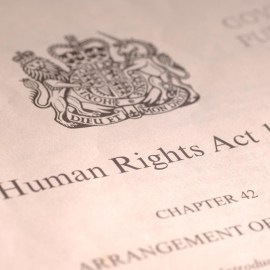 The much trumpeted commission on a UK Bill of Rights has been launched by the Ministry of Justice. It is pretty much as was leaked last week, although it will now have 8 rather than 6 experts chaired by Sir Leigh Lewis, a former Permanent Secretary to the Department of Work and Pensions.
The commission is to report by the end of 2012. Its members, described as “human rights experts”. Are they? The roll call, made up mostly of barristers, is:
Continue reading →
Like this:
Like Loading...
9 August 2010 by Adam Wagner

The Strasbourg court
A new Government report on the implementation of European Court of Human Rights judgments has highlighted the vexed issue of the rightful place of such rulings in domestic law. Many decisions, for example on prisoner voting rights, have languished unimplemented for years and it remains to be seen whether the Coalition Government will do any more to fulfil its legal obligations to the thousands affected.
The report sets out the Government’s position on the implementation of human rights judgments from the domestic and European courts. It is a response to the Joint Committee on Human Rights‘ March 2010 report, in which the committee criticised “inexcusable” delays in implementation.
The United Kingdom is obliged to implement judgments of the European Court of Human Rights under Article 46 of the European Convention on Human Rights. In 2009, the UK was found to have violated the European Convention 14 times, which represents 1% of the overall total of violations found by the Court. However, the UK has a high proportion of leading cases outstanding for more than 5 years.
Continue reading →
Like this:
Like Loading...
13 April 2011 by Adam Wagner
 Condliff, R (On the Application Of) v North Staffordshire Primary Care Trust [2011] EWHC B8 (Admin) (07 April 2011) – Read judgment
What happens when the money for medical treatment runs out? The National Health Service has a limited budget. It also is obliged by law to provide necessary medical services to the public. Inevitably, some treatments will be considered unaffordable, and this sometimes leads to court challenges.
Two such challenges have arisen recently. One is interesting because it has been rejected (unless it is appealed) by the High Court, and the reasoning behind that rejection highlights how difficult it is to succeed in such claims, especially on human rights grounds. The other, because of the way it, and in particular its human rights aspects, has been reported. Not quite bad enough to merit placing on the legal naughty step, but not far off.
Continue reading →
Like this:
Like Loading...



Recent comments