Category: In the news
11 November 2010 by Adam Wagner
 The Commons Public Accounts Committee has published a damning report into the Children and Family Court Service’s (‘Cafcass’) response to increased demand following the Baby P scandal.
Cafcass was established nine years ago to advise children and the courts in family proceedings. It has come under significant criticism in that time. The new report deals specifically with the 34% surge in care cases following the Baby P scandal. The report is damning, concluding that Cafcass is not fit for purpose, taking 27 days to allocate a case and finding itself unprepared for the increase of cases following Baby P’s death.
The child protection system is likely to be significantly reformed following the recommendations of Professor Eileen Munro, who has been asked by the coalition government to lead a “fundamental” review. Part 1 of the review can be found here.
Continue reading →
10 November 2010 by Rosalind English

R v Chaytor and others (Appellants) UKSC 2010/0195 (Awaiting judgment)
The Supreme Court has dismissed the appellants’ appeal from the decision of the Court of Appeal Criminal Division that the Crown Court does have jurisdiction to try a Member of Parliament in relation to the submission of an allegedly dishonest claim for Parliamentary expenses or allowances.
The Appellants had argued that the court was deprived of jurisdiction by either or both of (i) Article 9 of the Bill of Rights 1688; or (ii) the exclusive jurisdiction of Parliament.
As can be seen from our previous posts on this matter, the appellants had each been committed for trial in the Crown Court on charges of false accounting contrary to s 17(1) Theft Act 1968 arising from their submission of claims for parliamentary expenses and/or allowances at a time when each appellant was a sitting Member of Parliament. At a preparatory hearing the appellants contended that the Crown Court did not have jurisdiction to determine the charges by reason of parliamentary privilege.
Read more:
10 November 2010 by Rosalind English
 Robert Elwyn Watkins v Philip James Woolas [2010] EWHC 2702 (QB) 5 November 2010- read judgment
Update – read our 3 December 2010 post on his defeat in the administrative court
The Election Court has ruled that the Labour MP for Oldham knowingly and deliberately misled the constituency and as a result his election is void under Section 106 of the Representation of the People Act (1983). Permission for judicial review of the decision has been refused.
The provision of the 1983 Act makes it an offence for anyone to publish “any false statement of fact in relation to the candidate’s personal character or conduct” to prevent them being elected “unless he can show that he had reasonable grounds for believing, and did believe, that statement to be true”.
Continue reading →
10 November 2010 by Matthew Hill
 R (Booker) v NHS Oldham and Direct Line Insurance PLC [2010] EWHC 2593 (Admin)- read judgment
The High Court has held that where a claimant agrees a damages settlement that includes an indemnity to fund private nursing care should existing NHS provision be withdrawn, it was unlawful for a primary care trust to cease its funding of the claimant’s care on the basis that her needs would be met through the settlement.
The claimant, B, was a tetraplegic who had sustained her injuries in a road traffic accident. She had received care from the defendant NHS trust (“the Trust”) over a number of years, and there was no dispute that her medical needs made her eligible for future care. In October 2009, B’s personal injury case was settled on the basis of both a lump sum and periodical payments, the latter due to commence from 15 December 2011. In respect of the period between the settlement date and the first periodical payment, a series of “safety net undertakings” were given by both sides in the litigation, and by DLI, the insurer of the injury claim defendant. These were to the effect that B would use her best endeavours to maintain the NHS funded care that she was receiving, but, should it nonetheless be withdrawn, DLI would indemnify B against the cost of providing replacement care. In June 2010, the Trust informed B that it intended to withdraw its provision of care from her with effect from the autumn, on the basis that B had elected to receive private care and hence no longer required NHS services. B sought judicial review of this decision.
Continue reading →
9 November 2010 by Adam Wagner
 Updated | The Select Committee on the Constitution has published its report on the Public Bodies Bill, and has expressed concern that the Bill as proposed will impose “Henry VIII” powers on the Executive.
The Bill, which has already attracted attention for seeking to abolish 192 quangos, is currently making its way through Parliament (track its progress here) and has its second reading in the Lords on Tuesday 9th November. You can watch a recording of the debate here. The committee reports:
When assessing a proposal in a Bill that fresh Henry VIII powers be conferred, we have argued that the issues are ‘whether Ministers should have the power to change the statute book for the specific purposes provided for in the Bill and, if so, whether there are adequate procedural safeguards’. In our view, the Public Bodies Bill [HL] fails both tests.
Continue reading →
9 November 2010 by Adam Wagner
 The debate over whether control orders will survive the anti-terrorism review has been rumbling on for the past weeks, with a surprising amount of internal discussions being aired in public.
The human rights organisation Liberty, which opposes the orders, has posted a useful summary of the recent back and forth, which it calls (allegedly quoting the Prime Minister) a “car crash”. Reading the summary, it seems clear that there are a number of strongly held but opposing views within the coalition, apparently split down party lines. There also appears to be no clear picture from within the security services either.
Continue reading →
9 November 2010 by Rosalind English
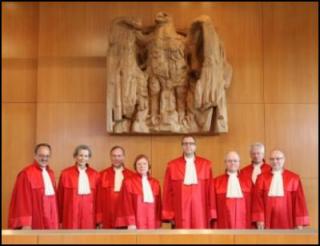 As we have seen from the recent ruling from the Supreme Court in Pinnock, British judges regard themselves as constrained to follow a “clear and consistent” line of authority from Strasbourg, even though the latter has no binding authority over the appellate courts in this country. Indeed, as we have noted in our post on the case, it overruled three of its own precedents without any ado.
How different the picture is in Germany, where the highest Constitutional Court, the Bundesverfassungsgericht, is armed with tremendous powers by the German Grundgesetz, or Basic Law, to uphold its own interpretation of national law in judgments that go to the heart of what the executive is or isn’t allowed to do.
Continue reading →
9 November 2010 by Guest Contributor
 The following is a guest post by Tom Blackmore, the grandson of David Maxwell Fyfe, a politician, lawyer and judge who was instrumental in drafting the European Convention on Human Rights, which has just celebrated its 60th anniversary (see our post). For those who argue that human rights are an invention of continental Europe, this article should provide food for thought:
In 1914 Rupert Brooke wrote:
If I should die, think only this of me:
That there’s some corner of a foreign field
That is for ever England. There shall be
In that rich earth a richer dust concealed;
A dust whom England bore, shaped, made aware,
Gave, once, her flowers to love, her ways to roam,
A body of England’s, breathing English air,
Washed by the rivers, blest by suns of home.
And think, this heart, all evil shed away,
A pulse in the eternal mind, no less
Gives somewhere back the thoughts by England given;
Her sights and sounds; dreams happy as her day;
And laughter, learnt of friends; and gentleness,
In hearts at peace, under an English heaven.
Continue reading →
8 November 2010 by Adam Wagner
 Updated | For those looking for clues as to how the Ministry of Justice will prioritise its funding after the impending 25% budget cut, it has just released its 2011-15 business plan.
The MoJ’s ‘vision’ is certainly ambitious. Despite the cuts, there will be “better law“. This will come from a programme of “fundamental reform” which will cure the problems of “too much litigation, too many people reoffending and too much money spent on systems”.
Under the heading “Coalition Priorities”, the MoJ provides its plans for structural reform. It is not clear whether these are in order of priority:
Continue reading →
8 November 2010 by Adam Wagner
 Today marks the beginning of National Pro Bono Week, with events being held across the country to celebrate the range and impact of pro bono work undertaken by solicitors, barristers and legal executives. A calendar of events can be found here.
How much pro-bono, or free, work should a lawyer do? This is a question which I have heard asked surprisingly rarely. I cannot recall the topic being addressed during my legal training, although pro-bono work was generally encouraged not just as charity but also as an excellent way of gaining legal experience with a view to finding a job. This was certainly my experience, and I cannot stress enough how valuable my work at the Free Representation Unit was in providing an interesting and valuable insight into representing real clients.
Continue reading →
8 November 2010 by Richard Mumford
 Updated | On 3 November the judge acting as coroner for the 7/7 inquests ruled that she does not have the power to hold secret hearings to hear evidence which, if made public, would pose a threat to national security. Dame Heather Hallett also ruled that although she, as a Court of Appeal Judge, could look at ‘intercept evidence’ governed by the Regulation of Investigatory Powers Act 2000 (“RIPA”), such material could not form part of the evidence at the inquests.
The fundamental problem faced by Hallett LJ, linking the two parts of her ruling, was what to do about intelligence material , the revelation of which “in unredacted form would threaten national security” but which might have a bearing on her findings at the inquests. The problem can be traced back to Hallett LJ’s earlier ruling concerning the issues to be determined at the inquest, in particular the requirement for:
Continue reading →
8 November 2010 by Guest Contributor
 Updated | On 5 November 2010 judgment was handed down in JIH v News Group Newspapers ([2010] EWHC 2818 (QB)) – Read judgment.
Update, 18 November 2010: The case has returned to the High Court after the Daily Telegraph reported a key detail relating to JIH’s identity. This was contrary – said JIH – to the court order. Mr Justice Tugendhat refused the application by JIH that his/her identity not be disclosed. However, he did sound a warning that “editors and publishers have regard to the “duties and responsibilities” referred to in Art 10(2) itself. These duties and responsibilities include a requirement that they comply with orders of the court, and that they take all necessary steps to ensure that journalists understand this necessity.” If they ignore that warning, warned the judge, they may be found in contempt of court.
This post by Mark Thomson first appeared on the media law blog Inforrm, and is reproduced with permission and thanks
Continue reading →
5 November 2010 by Adam Wagner

In
Updated | Today the UK courts have made two decisions in relation to radical Muslim clerics. The score card reads: Abu Hamza can keep his passport and stay (for now), but Dr Zakir Naik, an Indian preacher who was excluded from the UK by the Home Secretary in June, will remain unwelcome.
The Special Immigration Appeals Commission has ruled that Abu Hamza can keep his UK passport as if a deprivation order were made, he would be made stateless, as he claimed he had already been stripped of his Egyptian citizenship. By section 40 of the British Nationality Act 1981, the Secretary of State cannot make a person stateless. The UK is trying to deport him altogether, but his claim is being heard at the European Court of Human Rights (see our post).
Continue reading →
5 November 2010 by Adam Wagner
 Updated | For your weekend reading pleasure, some of this week’s human rights news, in bite-size form. The full list of our external links can be found on the right sidebar or here.
Abu Hamza wins passport appeal – BBC: Radical Muslim cleric Abu Hamza has won his appeal in the Special Immigration Appeals Commission against government attempts to strip him of his British passport. Apparently he won as taking his passport away would have rendered him “stateless”. We will comment on the case once the judgment is released (update – judgment is here and our post is here). In the meantime, you can read the background to his extradition appeal here.
A breathtaking Bill of which even Henry VIII would have been proud – Law and Lawyers: The Public Bodies Bill is making its way through Parliament, and the Law and Lawyers blog has sounded the alarm that the bill, if passed into law, will amount to a “permanent extension to Ministerial powers exercisable with quite minimal Parliamentary oversight.” It is “replete” with so-called Henry VIII clauses, which could provide unchecked power to the Executive. I discussed the issue of Henry VIII clauses in July, in light of the Lord Chief Justice’s comments on the issue.
Continue reading →
5 November 2010 by Adam Wagner

In a new article, Afua Hirsch discusses the difficult question of the place of religion in our courts, in light of comments made by a judge sentencing Roshonara Choudhry, a radicalised Muslim woman, for the murder of a Christian man.
The writer compares this case to Lord Carey’s recent appeal in a same-sex counselling case that religious cases be heard by religion specialists (see our post), as well as the official censure of a judge in a criminal damage case who made overtly political comments about the 2008/9 Israel-Gaza war (our post here). Hirsch argues that religious courts may be the answer to these problems, although this may be unfair to other groups affected by discrimination such as women and ethnic minorities.
Continue reading →



Recent comments