By: Rosalind English
9 November 2010 by Rosalind English
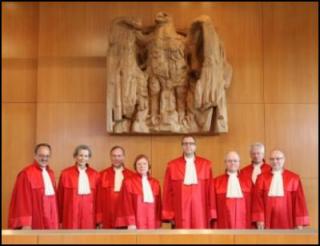 As we have seen from the recent ruling from the Supreme Court in Pinnock, British judges regard themselves as constrained to follow a “clear and consistent” line of authority from Strasbourg, even though the latter has no binding authority over the appellate courts in this country. Indeed, as we have noted in our post on the case, it overruled three of its own precedents without any ado.
How different the picture is in Germany, where the highest Constitutional Court, the Bundesverfassungsgericht, is armed with tremendous powers by the German Grundgesetz, or Basic Law, to uphold its own interpretation of national law in judgments that go to the heart of what the executive is or isn’t allowed to do.
Continue reading →
Like this:
Like Loading...
5 November 2010 by Rosalind English
 Updated | We posted earlier on the Supreme Court ruling in Manchester City Council (Respondent) v Pinnock (Appellant), that requires courts to be satisfied that any order for possession sought by local authorities must be “in accordance with the law”, and (ii) “necessary in a democratic society” – that is, that it should be proportionate in the full meaning of the word.
How far this takes us from the previous position, where the role of the county court was limited to conducting a conventional judicial review of the councils’ decision in such cases, remains to be seen.
Continue reading →
Like this:
Like Loading...
4 November 2010 by Rosalind English
 McLaughlin & Ors v London Borough of Lambeth & Anor [2010] EWHC 2726 (QB) – Read judgment
The High Court has been asked to consider whether the rule which prevents public authorities from suing in libel – to allow uninhibited criticism of government institutions – has the effect of preventing libel actions being taken by individual managers and employees of those institutions.
This was a claim by the defendants to strike out a libel action on grounds of abuse of process.The claimants are respectively head teacher, director of educational development and chairman of the governors of a primary school in Lambeth. The school was maintained by the first defendant pursuant to its statutory obligations. Now it is an Academy it is maintained by central government.
Continue reading →
Like this:
Like Loading...
28 October 2010 by Rosalind English
 Cadder (Appellant) v Her Majesty’s Advocate (Respondent) (Scotland) [2010] UKSC 43 Read judgment
We posted earlier on the Supreme Court’s ruling that an accused person’s rights under Article 6 of the Convention are breached if the prosecution leads and relies on evidence of the accused’s interview by police, if a solicitor was not present for that interview. Indeed Lord Hope thought it “remarkable” that
until quite recently, nobody thought that there was anything wrong with this procedure. Ever since ..1980, the system of criminal justice in Scotland has proceeded on the basis that admissions made by a detainee without access to legal advice during his detention are admissible. Countless cases have gone through the courts, and decades have passed, without any challenge having been made to that assumption.
Continue reading →
Like this:
Like Loading...
21 October 2010 by Rosalind English
 Radmacher (formerly Granatino) (Respondent) v Granatino (Appellant) [2010] UKSC 42 (On appeal from the Court of Appeal [2009] EWCA Civ 649) Read judgment
The Supreme Court has ruled that ante-nuptial arrangements should be binding and enforceable in ancillary proceedings. Thus in future it will be natural to infer that parties who enter into an ante-nuptial agreement to which English law is likely to be applied intend that effect should be given to it.
Although human rights were not in issue in this litigation, there is an interesting question to explore here in relation to the parties’ rights to peaceful enjoyment of their possession without interference by the state (in the form of a court order reversing the provisions of a private settlement). Now the Supreme Court has given nuptial agreements considerably more weight in the fall-out folllowing marital breakup the likelihood of a Convention-based challenge in this context falls away but does not disappear altogether because the statutory regime still obliges courts to interfere with agreements if they are considered unfair in any way, or prejudicial to the children of the marriage.
First, the following summary is based on the press release of the case published on the Supreme Court website.
Continue reading →
Like this:
Like Loading...
18 October 2010 by Rosalind English
 An injunction sought against the publication of certain information has been granted by the High Court in Northern Ireland under Article 2 (the right to life). The claimant also invoked the Prevention of Harassment (NI) Order and sought damages for misuse of private information. The Article 8 claim was only partially successful and the harassment claim was dismissed.
The claimant, who had been accused and subsequently cleared of murdering a journalist working for the defendant newspaper sought to prevent the publication of details relating to his address, his partner, his wedding plans and other personal information and photographs. The judge held that the publication of this information, in the light of threats from loyalist paramilitaries and dissident republican paramilitaries, would result in a “real and immediate risk” to the claimant’s life.
Continue reading →
Like this:
Like Loading...
15 October 2010 by Rosalind English
 Communications from an accountant giving legal advice do not attract legal professional privilege. The rule is only available if the advice is sought from a lawyer.
Notices under the Taxes Management Act 1970 (“Section 20 notices”) were served on the appellant company by the Revenue with a view to investigating a commercially marketed tax avoidance scheme. The appellant asserted that the notices required production of documents by which they sought or received legal advice on tax matters, in some cases from counsel and foreign lawyers, and in others from accountants.
Continue reading →
Like this:
Like Loading...
14 October 2010 by Rosalind English
 Full body scanners are to become the only security option for people flying out of Manchester Airport, the BBC reports today. The excessive amount of coverage given to the disapproval expressed by civil liberties groups has now been counterbalanced by passengers’ attitudes, since it appears that people actually prefer the scanners to the full body pat down, and have been voting with their feet.
According to Manchester Airport, 95% of travellers prefer the scanners and queuing times have been radically reduced. It takes 2 minutes to undergo a pat down, but a mere 27 seconds to pass through a scanner.
Continue reading →
Like this:
Like Loading...
8 October 2010 by Rosalind English
 In his speech to the Conservative party conference, The foreign secretary William Hague has outlined the government’s plans for securing the sovereignty of parliament against the pressure of the European Union. He said:
A sovereignty clause on EU law will place on the statute book this eternal truth: what a sovereign parliament can do, a sovereign parliament can also undo … this clause will enshrine this key principle in the law of the land.
One commentator notes: “Tories plan fresh attacks on human and workers’ rights”. Another that there would be “subtle legal perils”.
Continue reading →
Like this:
Like Loading...
5 October 2010 by Rosalind English
 DFT v TFD [2010] EWHC 2335 (QB) (27 September 2010) – Read the judgment
Updated | In a recent restraint of publication case, the High Court has assessed the conflicting requirements of open justice and freedom of speech versus the privacy interests of the applicant.
The High Court was asked to consider continuing restraint of publication of what was said to be private and confidential information. The applicant alleged that the respondent had been blackmailing or attempting to blackmail him, and had threatened to make public private and confidential information concerning a sexual relationship between them unless she was paid very substantial sums. The applicant not only sought continuation of the injunction restraining publication but a prohibition on publishing the fact of the order as well, to avoid “jigsaw” identification of the applicant by the media.
Continue reading →
Like this:
Like Loading...
30 September 2010 by Rosalind English
 We reported earlier on the threat by EC Justice Commissioner Viviane Reding to institute infringement proceedings against France in respect of its expulsion of Roma and the dismantling of their encampments. It seems now that the Commission itself may not have the stomach for an action expressly based on the ban on discrimination in the EC Treaty and the Free Movement Directive.
As the Darren O’Donavan reports in Human Rights in Ireland,
The Commission decided to threaten a less controversial legal action against France for not having correctly transposed the Free Movement Directive into national legislation.
Continue reading →
Like this:
Like Loading...
30 September 2010 by Rosalind English
 J M v. The United Kingdom – 37060/06 [2010] ECHR 1361 – Read judgment
The European Court of Rights has declared that rules on child maintenance prior to introduction of the Civil Partnership Act discriminated against those in same-sex relationships.
The events happened nearly a decade ago and the law in relation to same-sex couples has greatly altered since, so it will be of limited relevance to those paying child benefit now. Of more interest is the reasoning of the majority in deciding the case under the right to peaceful enjoyment of property rather than the right to family life.
The case summary is based on the Court’s press release, and is followed by my comment.
Continue reading →
Like this:
Like Loading...
28 September 2010 by Rosalind English

A group of lawyers, academics and campaigners has been deciding how to shake up our legal landscape to make the future safer for our environment.
Sixty years of human rights and it feels like they’ve been with us for ever. Two hundred and nine years since the founding fathers’ Bill of Rights came into effect in the United States; two hundred and eleven since the French National Assembly adopted the Declaration of the Rights of man. Now, there are more humans to seek out and flourish those rights than was ever imaginable in those brave new worlds.
In Paul Simon’s words, there are
Too many people on the bus from the airport
Too many holes in the crust of the earth
The planet groans
Every time it registers another birth
People’s rights and aspirations, as set out in these pioneering aristocratic instruments, may have reached the end of their useful life.
Continue reading →
Like this:
Like Loading...
23 September 2010 by Rosalind English
 Updated x 2 | Kay and Others v United Kingdom (European Court of Human Rights, 21st September) – Read judgment
The European Court of Human Rights has ruled that the UK violated the human rights of short-term tenants of council property whose leases had been terminated. The decision will not, however, prove much help to evicted tenants in similar situations in the future, although it should encourage courts to take their personal circumstances into account when deciding if they should be evicted.
The applicants were occupiers of housing units owned by Lambeth borough council under leases which had been provided by a charitable housing trust. Lambeth brought possession proceedings after the leases were terminated in 1999. The applicants complained that these proceedings breached their right to respect for private and home life under Article 8 (the right to a family life). They were unsuccessful before the domestic courts but the Strasbourg Court found a violation of Article 8, insofar as the applicants had been prevented from raising it as a defence.
Continue reading →
Like this:
Like Loading...
16 September 2010 by Rosalind English
In the ongoing row over France’s repatriation of Roma nationals there has been little debate over precisely what power the EU Commission has to initiate legal action against the French government.
Viviane Reding, the EU Justice Commissioner, is widely reported to have declared that France faces possible infringement proceedings and a fine from the European Court of Justice in respect of its dismantling of Roma camps and repatriation of up to a thousand Bulgarian and Romanian Roma citizens since last month. It is suggested that the French government is guilty of applying the 2004 Directive of Free Movement of Persons in a “discriminatory” fashion, offending not only directive’s own provisions, but the European Treaty’s principle of non discrimination (Article 19) and also, possibly, the ban on collective expulsion of aliens under Protocol 4 Article 4 of the European Convention on Human Rights.
Continue reading →
Like this:
Like Loading...



Recent comments