By: Adam Wagner
22 April 2011 by Adam Wagner
 When the prime minister criticises judges, he tends to speak from his gut. The prospect of prisoners being given the vote by European judges makes him feel “physically sick”. And now, he is “a little uneasy” about the rise of “a sort of privacy law without Parliament saying so“.
David Cameron’s use of visceral language may reflect what many in the general public (as well as PR man Max Clifford) are feeling about the issue of wide-ranging injunctions granted by courts, seemingly all the time, to prevent salacious details of celebrities’ private lives being revealed. The latest involves a former big brother contestant’s alleged affair with a married Premier League footballer.
Continue reading →
Like this:
Like Loading...
21 April 2011 by Adam Wagner
 This has been an interesting week for the continuing “debate” over the future of the European Court of Human Rights. Stay tuned for an explanation of the quotation marks.
First, Dominic Raab MP has released a pamphlet with the think-tank CIVITAS entitled Strasbourg in the Dock. Raab, a former lawyer, has been a vocal opponent of the European Court of Human Right as well as the Human Rights Act. The pamphlet can be read here and the press release and summary can be found here. He finds some of the European judges are “woefully lacking in experience” and, as a consequence, “are undermining the credibility and value of the Court“.
Continue reading →
Like this:
Like Loading...
19 April 2011 by Adam Wagner

There is a scene in the film Milk in which Harvey Milk, a gay rights leader and politician, counsels his young protegé Cleve Jones on how to rally an angry crowd. Cleve has been reading a convoluted speech to little effect, when Milk steps in to show him how it’s done.”Lose the note cards next time”, he tells Cleve, “your job is to say into that bullhorn what they’re all feeling”.
Geoffrey Robertson QC has taken Harvey Milk’s advice in a recent article in the Daily Mail in support of a British Bill of Rights. We can be angry about European human rights judges and the European Convention, says Robertson, because “human rights can be delivered without Europe infringing the sovereignty of the British Parliament” through a British Bill of Rights. He feels the pain of the Euro-sceptic case.
Continue reading →
Like this:
Like Loading...
18 April 2011 by Adam Wagner
 Update | the event is now full. I will publish any plans to live-stream / tweet for those who didn’t register in time.
Interested in a career in human rights? On 5 May 2011 from 1pm the Law Society and Human Rights Lawyers Association are running a free information day for budding human rights practitioners.
I am speaking at the event, but there are also lots of other interesting speakers (listed below)! All details and how to register are here.
The Law Society say:
Continue reading →
Like this:
Like Loading...
13 April 2011 by Adam Wagner
 The clock is ticking again on prisoner votes. The European Court of Human Rights has rejected the UK government’s latest appeal in the long-running saga.
The UK had attempted to appeal the recent decision in Greens and M.T. v. the United Kingdom. The full background can be found in my previous post, in which I predicted that the European court would find the UK’s appeal unappealing. It has, and the result is that the UK has just under six months to remove the blanket ban on prisoners voting.
Incidentally, Rosalind’s post from earlier today relates to a separate but also interesting Scottish court judgment on prisoner votes.
Continue reading →
Like this:
Like Loading...
13 April 2011 by Adam Wagner
 Condliff, R (On the Application Of) v North Staffordshire Primary Care Trust [2011] EWHC B8 (Admin) (07 April 2011) – Read judgment
What happens when the money for medical treatment runs out? The National Health Service has a limited budget. It also is obliged by law to provide necessary medical services to the public. Inevitably, some treatments will be considered unaffordable, and this sometimes leads to court challenges.
Two such challenges have arisen recently. One is interesting because it has been rejected (unless it is appealed) by the High Court, and the reasoning behind that rejection highlights how difficult it is to succeed in such claims, especially on human rights grounds. The other, because of the way it, and in particular its human rights aspects, has been reported. Not quite bad enough to merit placing on the legal naughty step, but not far off.
Continue reading →
Like this:
Like Loading...
11 April 2011 by Adam Wagner
 The US State department has released its 35th annual Country Reports on Human Rights Practices relating to over 190 countries. This includes a report on the United Kingdom, which can be access here and here (pdf).
The reports are mandated by US statute and require that the Secretary of State shall transmit to the Speaker of the House of Representatives and the Committee on Foreign Relations of the Senate, “a full and complete report regarding the status of internationally recognized human rights”, as set forth in the Universal Declaration of Human Rights. The UK Foreign Office has also recently published its own report into human rights around the world, which only deals with “countries of concern”, and as such doesn’t mention the US once in 355 pages .
Secretary of State Clinton introduced the US reports, saying:
Continue reading →
Like this:
Like Loading...
8 April 2011 by Adam Wagner
 The Master of the Rolls Lord Neuberger is either the busiest judge in England or relies heavily upon his assistant John Sorabji for his consistently thoughtful and excellent speeches. Either way, he has given another fascinating speech. Who are the masters now?
The question posed in the title is paraphrased from one asked in Parliament in 1946, which itself paraphrased Humpty Dumpty (see para 3). Neuberger used the second annual Lord Alexander of Weedon lecture (Lord Philips gave the first) to speak about the topical but, as I have posted, slippery issue of Parliamentary sovereignty. So, who is the master: the unelected judge or the elected politician?
Continue reading →
Like this:
Like Loading...
7 April 2011 by Adam Wagner
 BM v Secretary of State for the Home Department [2011] EWCA Civ 366 (05 April 2011) – Read judgment
Another control order has been ruled unlawful and quashed by the court of appeal, on the basis that the evidence relied upon to impose it was “too vague and speculative”.
Control orders are a controversial anti-terorrism instrument (see this post) which are soon to be replaced with Terrorism Prevention and Investigation Measures. These will impose less onerous restrictions upon a terrorist suspect. No doubt they will be approached by the courts at some stage. In the meantime, there are still 9 control orders in operation under the current regime. One has just been quashed by the court of appeal.
Continue reading →
Like this:
Like Loading...
5 April 2011 by Adam Wagner
 Are you a current or recent law student looking for funding to undertake a human rights project in the UK or abroad? The Human Rights Lawyers Association, of which I am a committee member, has £6,000 to give away for its 2011 bursary scheme.
The closing date for applications is 8 May 2011. For full details, click here or continue reading.
Continue reading →
Like this:
Like Loading...
23 March 2011 by Adam Wagner
 Lumba (WL) v Secretary of State for the Home Department [2011] UKSC 12 (23 March 2011) – Read judgment / press summary
The Supreme Court has ruled that it was unlawful and a “serious abuse of power” for the Home Office to follow an unpublished policy on the detention of foreign national prisoners which contradicted its published policy. Two convicted prisoners were therefore unlawfully detained.
This fascinating 6-3 majority decision could be important in respect of setting the boundaries for the courts’ scrutiny of executive powers. It is also, for the record, not a decision which is based on human rights. The appellants are both convicted criminals (and foreigners too), so the court may be criticised for upholding their human rights despite their criminal actions. But this is a case decided on traditional public law grounds, which preceded the human rights act by many years. As Lord Hope put it:
Continue reading →
Like this:
Like Loading...
22 March 2011 by Adam Wagner
 As the Cearta.ie blog reminds us this morning, the late Lord Bingham saw accessibility, intelligibility and predictability as central requirements for the effective rule of law. It is also central to the human right to a fair trial. On that theme, Lord Neuberger, the head of the court of appeal, gave a speech last week which sought to push that agenda forward in the internet age.
But what comes next? In order to push forward the open justice agenda, ideas will have to be practically worked through, and funded. Please use the comments section of this post to let us know what you think, what you make of the ideas in Neuberger’s speech and whether you have any ones of your own.
Continue reading →
Like this:
Like Loading...
21 March 2011 by Adam Wagner
 Updated | The housing minister Grant Shapps wrote in yesterday’s Sunday Telegraph that he wants to make squatting a criminal offence and “shut the door to squatters once and for all”
The changes to the law are being investigated by the Ministry of Justice at the moment (update: read the government’s press release and new guidance here). They will be of interest from a human rights perspective, although aspects of the UK’s current approach to squatters rights were declared compatible with the European Convention on Human Rights by the grand chamber European Court of Human Rights in the 2007 case of JA Pye (Ocford) LTD v. United Kingdom.
What is interesting about the proposed clarifications and changes to the law is the way in which they were reported.
Continue reading →
Like this:
Like Loading...
20 March 2011 by Adam Wagner
 Updated | It all started with the reporting of an injunction, supposedly obtained by former Royal Bank of Scotland chief executive, “preventing him being identified as a banker”. A mildly interesting story, made marginally more so by the fact that the injunction had been breached by an MP during a Parliamentary debate.
But there is more to the story. As bloggers Anna Raccoon, Charon QC and Obiter J have reported, on a Parliamentary debate on Thursday the same Liberal Democrat MP, John Hemming, revealed the details of a number of other (what he called) “hyper” injunctions. The common feature was that courts had ordered not only that the parties to litigation were to be prevented from revealing details of their cases to the public, but also to their MPs.
Continue reading →
Like this:
Like Loading...
18 March 2011 by Adam Wagner
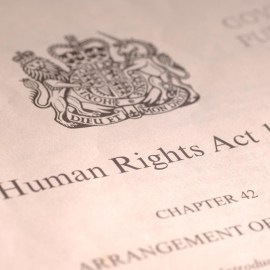 The much trumpeted commission on a UK Bill of Rights has been launched by the Ministry of Justice. It is pretty much as was leaked last week, although it will now have 8 rather than 6 experts chaired by Sir Leigh Lewis, a former Permanent Secretary to the Department of Work and Pensions.
The commission is to report by the end of 2012. Its members, described as “human rights experts”. Are they? The roll call, made up mostly of barristers, is:
Continue reading →
Like this:
Like Loading...



Recent comments