Bill of Rights
23 September 2012 by Adam Wagner
 Jonathan Fisher QC wrote an opinion piece in last week’s Jewish Chronicle entitled “The wrongs of human rights“. The article is highly critical of the human rights movement and raises the alarm over recent decisions on religious rights and “growing attacks on our traditions”. It also makes a strong case for the adding of a list of “responsibilities” to the Human Rights Act, which Fisher argues would be “more closely aligned with Judaism’s approach”. The article pulled no punches and chose the most emotive of starting points:
Using human-rights principles to attempt to ban circumcision in Germany is a grotesque insult to the memory of Holocaust victims. The Jewish jurists who helped inspire the human-rights movement must be spinning in their graves at the intellectual violence that their legacy has spawned.
I have written before about the misuse of the Holocaust to justify arguments for reforming the Human Rights Act (the human rights debate has its own version ‘Goodwin’s Law‘). But I will leave the substance of the article for another day – I will be responding soon in the same newspaper. Rather, I wanted to discuss the timing of the article.
As regular readers may know, Fisher is one of the eight member of the Commission on a Bill of Rights, which is currently consulting the public for a second time (see my post). The consultation is closing on 30 September 2012 and the Commission is due to report before the end of the year. No mention is made of the fact that Fisher is a Bill of Rights Commissioner; he is described as a “visiting professor of law at the London School of Economics”.
Does anyone else find this a little odd?
Continue reading →
Like this:
Like Loading...
19 September 2012 by Guest Contributor
 It’ll all be over by Christmas: that’s what the coalition promised when it established the Commission on a Bill of Rights to, among other things:
… investigate the creation of a UK Bill of Rights that incorporates and builds on all our obligations under the European Convention on Human Rights, ensures that these rights continue to be enshrined in UK law, and protects and extends our liberties.
With less than four months to go, it seems a good time to reflect upon its work. My premise is that the process by which a bill of rights is created is as important as the outcome if the bill is to enjoy longevity and democratic legitimacy, in the sense of having been subject to inclusive and informed public deliberation. This lesson has been learned in contexts from Northern Ireland to Australia, where energetic consultation processes were designed using community organising techniques, televised hearings, the internet, social networking and other creative forms of public engagement. These are explored in research I conducted for the Equality and Human Rights Commission ahead of the 2010 general election.
Continue reading →
Like this:
Like Loading...
31 May 2012 by Rosalind English
 Writing on the Richard Dawkins website, humanist campaigner Leo Igwe-Ieet declares that there is a gaping hole in the protections listed in international rights instruments.
I have heard it proclaimed at the UN that the rights of women are human rights. I have also heard it proclaimed that the rights of gay people are human rights. These proclamations changed the way human rights are perceived around the globe. Personally I have yet to hear it proclaimed at UN, or at our regional and national human rights bodies that the rights of atheists, agnostics and freethinkers are human rights. I do not want these rights to be implied or assumed as currently the case in most countries. I want them to be expressly declared as universal human rights.
The reason why such explicit protection is urgently needed, the writer claims, is because non-believers are particularly vulnerable in some parts of the world, notably Africa. In parts of Africa where fundamentalist belief holds sway, “religious non-believers are treated as if they are not human beings, as if they do not exist or do not have the right to exist.” The right to freedom of religion is of no avail to those who wish to eschew faith altogether. On the contrary,
freedom of religion is often understood as freedom to profess a religion-the religion sanctioned by the state, by one’s family or community- not freedom to change one’s religion or freedom not to profess any religion at all as contained in article 18 of the Universal Declaration of Human Rights.
Continue reading →
Like this:
Like Loading...
6 December 2011 by Rosalind English
 Behind the Times paywall Anthony Lester today declares that “Sniping at Strasbourg will only hinder reform”. In his guest column, he says that Court is suffering unfair criticism from “sections of the British media” and “politicians who accuse it of over-reaching its power”. That may well be the case, but the most searing and authoritative criticism comes not from politicians or the press but from Lord Lester’s own profession – see Jonathan Sumption QC’s recent broadside (and our post) and Lord Hoffmann’s much-discussed analysis (posted here).
If the Court is indeed hobbled by unfair squibs and arrows from a resentful sector of the British populace, as Lord Lester suggests, why is the prisoner votes example the only one he can come up with? That is an important fight, at least from a constitutional angle, but not the only flashpoint; the Court’s tendency to act as fourth instance appeal tribunal particularly on deportation and terrorism cases is arguably far more “dangerous” and certainly of concern to more people than votes for prisoners.
Continue reading →
Like this:
Like Loading...
8 November 2011 by Adam Wagner
 The Commission on a Bill of Rights consultation on whether we need one (a bill, not the Commission) closes this Friday 11 November.
The consultation document is here: Do we need a UK Bill of Rights. You can respond by email or to the Commission’s address. Our posts on the commission are here and listed below for background – you can also read our existing Bill of Rights, from 1689, here, the Magna Carta here and the Human Rights Act here.
I intend to collate responses and summarise them once the deadline passes, so please feel free to email your responses (ideally as an MS Word document or PDF) to 1crownofficerow@gmail.com .
Continue reading →
Like this:
Like Loading...
25 October 2011 by Adam Wagner
 At around the same time that 79 Conservative Party MPs were rebelling over a European referendum, the Conservative Attorney General was giving a very interesting speech entitled European Convention on Human Rights – Current Challenges.
In a month in which the Justice Secretary called part of the Home Secretary’s speech on human rights “laughable” and “childlike”, Dominic Grieve presented a refreshingly grown-up argument on human rights reform.
The speech is worth reading in full. Grieve presented the Government’s arguments, most of them already well-known, on why the Human Rights Act needs to be replaced by a Bill of Rights. There were no big surprises; his central theme, subsidiarity, that is the European Court giving member states more space to set their local social policy, is something which the Justice Secretary has spoken about – see my post on his evidence to the European Scrutiny Committee.
Continue reading →
Like this:
Like Loading...
18 March 2011 by Adam Wagner
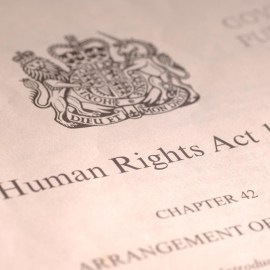 The much trumpeted commission on a UK Bill of Rights has been launched by the Ministry of Justice. It is pretty much as was leaked last week, although it will now have 8 rather than 6 experts chaired by Sir Leigh Lewis, a former Permanent Secretary to the Department of Work and Pensions.
The commission is to report by the end of 2012. Its members, described as “human rights experts”. Are they? The roll call, made up mostly of barristers, is:
Continue reading →
Like this:
Like Loading...
10 March 2011 by Adam Wagner
 Lord Anthony Lester, Helena Kennedy QC and Martin Howe QC are to sit on the upcoming commission on human rights reform, the press are reporting this morning.
Lester and Kennedy are both well-known human rights experts. Howe has long-standing proponent of replacing of the Human Rights Act with a bill of rights.
According to The Sun, which says the “probe on how to tackle power-crazy Euro judges is being held up by bickering Tories and Lib Dems“, the 7-strong commission will also include another Liberal Democrat nominee (in addition to Lester), two more members appointed by the Tories and a senior Ministry of Justice civil servant. It will have to report by December 2012.
Continue reading →
Like this:
Like Loading...
30 July 2010 by Adam Wagner
 Morley & Ors v. R [2010] EWCA Crim 1910 – Read judgment
Four former Members of Parliament have failed in their appeal of a Crown Court ruling preventing them from claiming parliamentary privilege in criminal proceedings arising from the parliamentary expenses scandal.
The appeal was of Mr Justice Saunders’ ruling in the Southwark Crown Court that the parliamentary privilege enshrined in the 1688 Bill of Rights does not extend to protecting the four ex-MPs, Elliott Morley, David Chaytor, James Devine and Lord Hanningfield, from prosecutions for claiming inflated expenses. He had said that he could “see no logical, practical or moral justification for a claim for expenses being covered by privilege; and I can see no legal justification for it either.”
The Lord Chief Justice gave the judgment of the court, and made clear that Parliamentary privilege was simply not designed to protect these four men from the allegations currently against them:
Continue reading →
Like this:
Like Loading...
14 June 2010 by Adam Wagner
Morley & Ors, R. v [2010] EW Misc 9 (EWCC) (11 June 2010) – Read judgment
Four former Members of Parliament have failed in their initial bid to claim parliamentary privilege in criminal proceedings arising from the parliamentary expenses scandal. The case has highlighted constitutional principles which reach back hundreds of years to the time of Oliver Cromwell, and raises questions of whether parliamentarians are above the criminal justice system.
This will not be the end of the affair, however, as leave to appeal has been granted with the case to be heard by the Court of Appeal as early as before the end of this month
Mr Justice Saunders sitting the Southwark Crown Court ruled that the parliamentary privilege enshrined in the 1688 Bill of Rights does not extend to protecting the four ex-MPs, Elliott Morley, David Chaytor, James Devine and Lord Hanningfield, from prosecutions for claiming inflated expenses.
Continue reading →
Like this:
Like Loading...
8 June 2010 by Rosalind English
 Prime Minister David Cameron has been busy preparing the country for “painful” cuts to pensions, pay and benefits. In a recent Guardian Article, The changing face of human rights, Afua Hirsch comments with approval on the 2008 recommendation by the Joint Committee on Human Rights that a new UK bill of rights should include the rights to health, education, housing and an adequate standard of living. Rosalind English asks whether the time has indeed come for “economic” human rights.
Ms Hirsch cites a number of examples around the world where such “social and economic rights” have been used successfully to challenge government policy on the distribution of healthcare, housing and benefits. Why, then, she asks, is such an extension of our existing rights so strenuously resisted in this country?
Continue reading →
Like this:
Like Loading...
1 June 2010 by Adam Wagner
 We have been following the debate on whether Britain will opt to supplement the Human Rights Act with a Bill of Rights. In a wide-ranging article published today, Geoffrey Robertson QC, a barrister specialising in human rights, has advocated “moving on from the Euro Convention – building on it, but not abandoning it.”
In the article, he concludes:
Despite these inadequacies, there is ample evidence that the Human Rights Act has measurably improved the level of dignity and decency accorded by the state to its most-vulnerable citizens, and for that relief much thanks to the Blair government which enacted it with cross-party support in 1998. But it has not, as its proponents hoped, conduced to a “culture of liberty”….
Continue reading →
Like this:
Like Loading...
29 April 2010 by Adam Wagner

The ghost of Cromwell?
With all of the talk of the Conservative Party’s proposed new Bill of Rights, it is easy to forget that we have had one on the statute books since 1688. This will now be brought into sharp focus through the Parliamentary expenses scandal, where three ex-MPs are planning to use the 322-year old Act to argue that their prosecutions should be dropped as they have Parliamentary privilege.
The 1688 Bill of Rights (passed by Parliament in 1689) established many of the democratic rights which now find form in the European Convention on Human Rights (ECHR) and other similar sources, such as the First Amendment of the United States Constitution. Some of the language is familiar, such as the provision against “cruel and unusual punishments”, which foreshadows Article 3 of the ECHR.
The intention of the 1688 Act, which is still in force, was to establish rights seen as essential to restricting the power of the monarch, and bolstering the power and independence of Parliament. The Sovereign was restricted, for example, from establishing new courts or act as judge.
The key provision in respect of the three ex-MPs is:
That the Freedome of Speech and Debates or Proceedings in Parlyament ought not to be impeached or questioned in any Court or Place out of Parlyament.
Joshua Rozenberg, in a very interesting Law Society Gazette article, outlines the main issue:
The 1688 act is still in force, and there is no doubt that it protects MPs and peers from legal action over what they say in parliament. But what is meant by ‘proceedings’? Does it cover a claim for parliamentary expenses? The defendants say it does.
And who should decide such a question? The former MPs are expected to argue that leaving it to the courts would interfere with separation of the powers, a fundamental constitutional principle under which the judges do not question the way in which parliament conducts its affairs.
The Bill of Rights is still occasionally cited in court. One notable example was during the “cash for questions” affair in the 1990s. Neil Hamilton, then a member of Parliament, brought an action in libel against The Guardian newspaper. The trial was stopped, as Mr Justice May considered that the prohibition on courts questioning Parliamentary proceedings would prevent The Guardian obtaining a fair trial. This led directly to the drafting of s.13 of the Defamation Act 1996 which allows someone being sued for defamation to waive “the protection of any enactment or rule of law which prevents proceedings in Parliament being impeached or questioned in any court or place out of Parliament.”
In his article, Rozenberg goes on to discuss what he considers to be the comparative case of Les Huckfield, a Member of the European Parliament who was accused of dishonestly obtaining expenses of over £2,500 by deception.
Old and new
Clearly the battle lines are now being drawn in what will be interesting and potentially important litigation from a perspective of constitutional law. It is also an odd coincidence that three ex-MPs may save themselves from prison by citing a 322-year-old bill of rights at the same time that their Parliamentary ex-colleagues are attempting to enact a brand new one.
Like this:
Like Loading...
28 April 2010 by Adam Wagner
 Three interesting press articles on proposals for a Bill of Rights:
The Northern Irish perspective – Monica McWilliams, chief commissioner for Human Rights in Northern Ireland writes in The Guardian: “The Human Rights Act is central to the constitutional DNA of the UK. It underpins the devolution settlements while simultaneously elucidating the common values of the constituent nations. It also provides a necessary platform from which the sense of autonomy that devolution brings can be further built upon.” (see our post on the subject)
The NGO perspective: Qudsi Rasheed, Legal Officer for JUSTICE, the human rights NGO, writes in The Guardian: “The Conservative party’s approach to this issue has been cloak and dagger. The commission of lawyers set up by David Cameron to consider the bill of rights has been extremely secretive and none of its work has been published. Short of vague and often contradictory statements and political rhetoric by various members of the party, there has been very little in the way of concrete proposals and suggestions.”
The Australian perspective: The Australian Newspaper editorial on why the Australian Prime Minister, Kevin Rudd, was right to reject proposals for an Australian Bill of Rights: “The Rudd government’s decision last week to reject the idea of codifying rights is a recognition that Australia’s robust constitution, its strong parliamentary tradition of lawmaking, its independent judiciary, and its intelligent civic culture are the best protections for citizens. Far from protecting minority rights, statutory codification risked pitting the judiciary against the parliament by, in effect, becoming a third house of parliament.“
Like this:
Like Loading...
23 April 2010 by Adam Wagner

Lord Phillips
Lord Phillips, the head of the Supreme Court, spoke to lawyers this week on the future of the Human Rights Act 1998, which the Conservative Party have threatened to repeal. He said that now that the Act is in place, it would be very difficult to imagine a court ignoring the rights enshrined by it, even if it were repealed.
We will post the full speech if and when it becomes available. In the mean time, Afua Hirsch writing in the Guardian summarises his argument (reproduced after the page break below).
On a second-hand reading, it does seem somewhat hopeful to assume, as Lord Phillips appears to, that if the Act were repealed courts would still place rights in anything like the central position they have been since the its passing, largely through momentum. Lawyers tend to concentrate on points which win cases, rather than on first principles, and whilst human rights were a relevant consideration before the Act’s passing (judgments of the European Court of Human Rights were persuasive but not binding), they amounted to little more that.
That said, the Conservative party have pledged to replace the Act with something similar, a Bill of Rights. It is not yet clear what form it will take, but it is highly likely that the European Convention on Human Rights will be the starting point for its drafting, and it is likely to be a recalibration rather than a replacement. As such, human rights are most probably “here to stay”, but we should not overestimate the constitutional power of judges, or underestimate the power of Parliament to set the legal agenda.
Update 27/04/10
Continue reading →
Like this:
Like Loading...



Recent comments