Search Results for: prisoners/page/36/ministers have been procrastinating on the issue, fearing that it will prove unpopular with the electorate.
20 April 2012 by Guest Contributor
 The Abu Qatada deadline debacle has once again thrust the European Court of Human Rights – and in particular, its relationship with the UK – into unwanted controversy just as European representatives gathered in Brighton to debate the Court’s future. This new fracas over the deportation of Abu Qatada has acted as a lightning rod for well-rehearsed criticisms of the Strasbourg Court – that it is a ‘meddling pseudo-judiciary’ and the enforcer of a villains’ charter.
A new report for the Equality and Human Rights Commission by researchers at London Metropolitan University and LSE, including myself, addresses these critiques as part of a broad analysis of the relationship between the UK and Strasbourg.
Among those interviewed for the report were the President of the European Court, Sir Nicolas Bratza; the outgoing Council of Europe Commissioner for Human Rights, Thomas Hammarberg; and, in the UK, Baroness Hale, Sir John Laws and Jack Straw, along with two members of the Commission on a Bill of Rights, Lord Lester QC and Anthony Speaight QC. The report also conducts a thematic analysis of case law, as well as examining wider literature and the voluminous statistics produced by the Court.
Continue reading →
Like this:
Like Loading...
5 October 2011 by Rosalind English
 Schrödinger would be rolling in his grave. The nation is abuzz with talk of a cat. A cat that is simultaneously there or not there. The speakers at yesterday’s seminar at Inner Temple hall on Strasbourg and the UK: Dialogue or Conflict, felt it incumbent to start each of their talks with a Cat Joke. But behind all this mirth about a supposedly “ridiculous” Article 8 decision, lie three serious points, some of which were touched on during the seminar though perhaps not with the detail they deserved.
First, it is not the cat that has toxified the debate about Article 8 and the vexed question of deportation. The right to respect under Article 8 is not only to family ties – however absurdly extended – but to private life itself. Article 8 also protects the right to establish and develop relationships with other human beings and the outside world and can sometimes embrace aspects of an individual’s social identity, (Niemietz v Germany (1992)). Therefore if a court wants to prevent the what it perceives as the unjust deportation of the individual before it, it has a much wider constellation of interests to turn to than the family circle, whether or not that involves companion animals. Some might even take the view that attachment to such an animal may evince a more genuine emotional tie than many that have been advanced to claim the protection of Article 8.
Continue reading →
Like this:
Like Loading...
24 July 2015 by Thomas Raine

Beggs v Scottish Ministers [2015] CSOH 98, 21st July 2015 – read judgment
The Court of Session’s first instance chamber – the Outer House – has held that the way in which the Scottish Prison Service (SPS) handled a prisoner’s correspondence breached Article 8 of the European Convention on Human Rights.
The petitioner, William Beggs, was a prisoner at HMP Glenochil until March 2013 and thereafter at HMP Edinburgh. In 2001 he was sentenced to life imprisonment for the 1999 murder of 18 year-old Barry Wallace, whose dismembered body parts Beggs disposed of in Loch Lomond.
Continue reading →
Like this:
Like Loading...
19 September 2012 by Andrew Tickell

Brought to you by Andrew Tickell
Rhubarb, rhubarb. Another defeat for the United Kingdom in Strasbourg yesterday. In James, Wells and Lee v. the United Kingdom, a chamber of the Court’s Fourth Section held that indeterminate sentences of imprisonment for public protection infringed Article 5 of the Convention. At his first Justice Questions in the House of Commons yesterday, our fresh-minted Conservative Lord Chancellor and Justice Secretary, Chris Grayling, advised MPs that:
“I’m very disappointed with the ECHR decision this morning. I have to say, it is not an area where I welcome the Court, seeking to make rulings. It is something we intend to appeal.”
One wonders which areas Mr Grayling would welcome the Court’s jurisdiction, but all in all, a somewhat tepid response from a man whose appointment was greeted by the Daily Mail with the enthusiastic suggestion that Grayling…
“… unlike his predecessor Ken Clarke, will have no truck with the cardboard judges at the European Court of Human Rights.”
Continue reading →
Like this:
Like Loading...
9 August 2011 by Melina Padron
 Welcome back to the human rights roundup, a regular bulletin of all the law we haven’t quite managed to feature in full blog posts. The full list of links, updated each day, can be found here. You can also find our table of human rights cases here.
by Melinda Padron
In the news last week
Torture, top-secret documents and the boycott to the detainee inquiry
Last week some of the key UK human rights campaign groups decided to boycott the Detainee Inquiry on the basis that it lacks credibility and transparency, with much of the relevant evidence and information to remain secret – see Matthew Flinn’s post asking whether the inquiry will be human rights compliant.
Responding to the boycott, the Inquiry issued a statement that it will still go ahead as planned. Watching the Law blog opines that without the involvement of these bodies (which include the likes of Liberty, Reprieve, Amnesty International and Justice) the Inquiry is highly unlikely to command any public confidence.
Continue reading →
Like this:
Like Loading...
1 April 2019 by Rosalind English
In the news
With a third rejection of Theresa May’s deal on Friday, Brexit remains a dismal subject. Dismal not only for its economic but for its human rights implications: this week, the Parliamentary Joint Committee on Human Rights published its report on the Immigration and Social Security Co-ordination (EU Withdrawal) Bill. The report (available here) raises concerns about legal limbo for the 3m EU citizens remaining in the UK post-Brexit. In particular, it makes the following recommendations:
- The bill in its present form is a ‘blank cheque’ affording ministers excessive discretion to remove rights. The JCHR recommends an amendment requiring the Secretary of State to ensure that any regulations contain measures to protect the acquired rights of persons who benefited from EU free movement of persons prior to Brexit.
- The EU Settlement Scheme is unclear on the implications of failure to register the time limit. The JCHR recommends provisions for registration outside the time limit, and/or otherwise to limit the implications of the time limit.
- The EU Settlement Scheme in its present form would issue only electronic proof of a successful application. The JCHR recommends the issuing of physical proof, echoing the EU Justice Committee in a comparison to the Windrush scandal on this point.
- Vulnerable people may have difficulty in accessing the EU Settlement Scheme. The JCHR recommends that steps be taken to ensure that vulnerable people are aware of their rights, and have assistance in accessing the scheme.
- Finally, the JCHR recommends clarification of the Common Travel Area for Irish citizens.
Continue reading →Like this:
Like Loading...
9 June 2013 by Sarina Kidd
 Welcome back to the UK Human Rights Roundup, your regular Royal Variety Show of human rights news. The full list of links can be found here. You can also find our table of human rights cases here and previous roundups here.
This week, there was a flurry of comment and critique on the Ministry of Justice’s paper, ‘Transforming Legal Aid’, human rights abuses both past and present are in the spotlight and there have been some notable decisions from the courts.
by Sarina Kidd
Continue reading →
Like this:
Like Loading...
1 August 2011 by Lucy Series
 Since BBC Panorama revealed shocking abuse of adults with learning disabilities in a private hospital run by Castlebeck Care Ltd, the care sector has engaged in widespread soul searching.
Paul Burstow instructed the Care Quality Commission (CQC) to carry out a national audit of all hospital services for adults with learning disabilities. Similar national audits were conducted following previous scandals relating to widespread abuse of adults with learning disabilities in Cornwall (here and here). In the CQC’s preliminary report on other Castlebeck services they expressed serious concerns about compliance with essential standards of quality and safety.
The human rights issue that stand out most powerfully in these reports is the widespread interference with patients’ autonomy and privacy. Take these finding from the report on Arden Vale, for instance:
Continue reading →
Like this:
Like Loading...
18 May 2020 by Alethea Redfern
This afternoon, health secretary Matt Hancock made a statement in the Commons updating the house on the government’s response to the crisis.
The health secretary announced that anyone in the UK aged five and over who has coronavirus symptoms will be eligible for a test. From today, recognised symptoms include the loss of smell and taste, as well a persistent cough and a high temperature. Hancock confirmed for the first time that the government has recruited over 21,000 contact tracers, including 7,500 health care professionals, to manually trace and get in contact with anyone who has tested positive.
In addition, he offered a degree of clarification in relation to the government’s new contact tracing app. The function of the app is to alert people of the need to self-isolate if they have come into proximity with an individual who reported coronavirus symptoms.
Continue reading →Like this:
Like Loading...
30 October 2013 by Adam Wagner
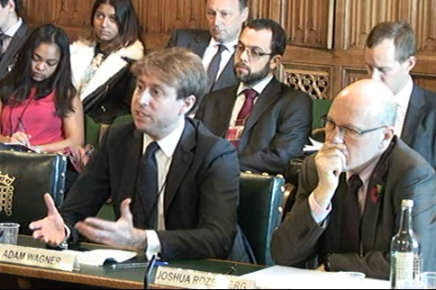 This morning Joshua Rozenberg and I gave evidence the Joint Select Committee on the Draft Voting Eligibility (Prisoners) Bill. You can watch our evidence session here – we are on from 10:34:30.
It was an interesting experience. There is clearly a range of views on the committee, to say the least. It will be fascinating to see what happens next – it is already almost a year since the draft bill was published and, as Joshua Rozenberg said, it seems quite possible that this issue will not be resolved one way or the other before the 2015 General Election, which is only 18 months away.
Continue reading →
Like this:
Like Loading...
14 October 2013 by Sarina Kidd
 Welcome back to the UK Human Rights Roundup, your regular full brass band of human rights news and views. The full list of links can be found here. You can find previous roundups here. Post by Sarina Kidd, edited and links compiled by Adam Wagner.
This week, Lord Neuberger implied that even if the Human Rights Act were to be abolished, the court would continue to uphold human rights, perhaps foreshadowing the Supreme Court’s decision in Osborn. Meanwhile, the controversial Immigration Bill now has its overarching documents available, LSE are looking to create a written constitution and the Daily Mail are in trouble, again.
Continue reading →
Like this:
Like Loading...
23 November 2015 by Hannah Lynes

In the news
LGBT campaigners have called for an urgent reform of the law, following the death of 21 year-old transgender woman Vicky Thompson in an all-male prison. Ms Thompson had previously said that she would take her own life if she were placed in a prison for men.
The system of locating transgender people within the prison estate has recently come into criticism after transgender woman Tara Hudson was placed at HMP Bristol, an all-male establishment. Ms Hudson spoke of being sexually harassed by other prisoners, before a petition signed by more than 150,000 people led to her eventual transfer to a women’s prison. Statistics from the US suggest that transgender women in male prisons are 13 times more likely than the general prison population to be sexually assaulted while incarcerated.
Under the current rules, in most cases prisoners must be located “according to their gender as recognised under UK law”, although the guidance allows discretion where the individual is “sufficiently advanced in the gender reassignment process.” But the case of Vicky Thompson has been said to show that “the law is simply not working. For people living for years as women to be sent to serve sentences in prisons for men is inviting disaster.”
Responding to a question on the issue, Parliamentary Under-Secretary of State for Justice, Andrew Selous has stated that the government intends to implement “revised policy guidance… in due course.”
In other news:
- The Guardian: The Metropolitan Police has issued an unreserved apology and paid substantial compensation to women who were deceived into forming long-term intimate sexual relationships with undercover police officers. The police force acknowledged that the relationships had been “a violation of the women’s human rights, an abuse of police power and caused significant trauma.”
- BBC: Members of the public and journalists will be permitted to attend the majority of hearings in the Court of Protection, where issues affecting sick or vulnerable people are heard. The new pilot scheme is intended to provide greater transparency, whilst safeguarding the privacy of the people involved.
- MPs on the justice select committee have called for the scrapping of the criminal courts charge, voicing “grave misgivings” about whether it is “compatible with the principles of justice.” The charge of up to £1,200 is imposed on convicted criminals, and is not means-tested. In its report, the parliamentary committee expressed concern that the charge, which is higher for those convicted after pleading not guilty, was creating “perverse incentives” affecting defendant behaviour. The BBC reports here.
- The Legal Voice: The Ministry of Justice has announced that the introduction of duty provider contracts will be postponed until 1 April 2016. A number of legal proceedings have been issued, challenging the legitimacy of the procurement process. The decision has been welcomed by the Bar Council, which has consistently opposed measures it claims would “damage access to justice and the provision of high quality advocacy services.”
- BBC: A couple from north west London have been found guilty of keeping a man enslaved in their home for 24 years, in “a shocking case of modern slavery.” The couple had “total psychological control” over their victim, threatening that if he left the house he would be arrested by police as an illegal immigrant.
In the courts
The Court found that a family of asylum seekers evicted from an accommodation centre had been exposed to degrading treatment, in violation of their rights under article 3 ECHR. The family had been left in conditions of extreme poverty, without basic means of subsistence for a period of four weeks. The Belgian authorities had not paid due consideration to the vulnerability of the applicants, who had small children including a seriously disabled daughter.
UK HRB posts
Best interests, hard choices: The Baby C case – Leanne Woods
Hannah Lynes
Events
If you would like your event to be mentioned on the Blog, please email the details to Jim Duffy, at jim.duffy@1cor.com.
Like this:
Like Loading...
8 March 2016 by Kate Richmond

Two important Supreme Court judgments concerning vicarious liability were handed down last week.
Mohamud v WM Morrison Supermarkets [2016] UKSC 11 affirms the “close connection” test set out in Lister v Hesley Hall Ltd [2001] UKHL 22 and rejects the formulation of a new test for vicarious liability based on “representative capacity”.
Cox v Ministry of Justice [2016] UKSC 10 extends the sorts of relationships where a defendant can be made vicariously liable for the conduct of an individual and evaluates Various Claimants v Catholic Child Welfare Society [2012] UKSC 56 (the ‘Christian Brothers’ case)
The two judgments are intended to be complementary; Mohamud addresses the relationship between the defendant and the wrongdoer while Cox centres on the sufficiency of connection between that relationship and the wrongdoer’s act such that the defendant can be held vicariously liable.
Mohamud
The claimant was assaulted at a Morrisons petrol station by an employee, Mr Khan. The claimant had entered the petrol station and had enquired about using printing facilities. Mr Khan responded using foul, racist and threatening language before following the claimant out ino the forecourt where Mr Khan punched and kicked him.
The Court of Appeal found that there was not a sufficiently close connection between what Mr Khan was employed to do and his tortious conduct so as to give rise to vicarious liability on the part of Morrisons. The “close connection” test was applied as laid down by Lord Steyn in Lister.
Lord Toulson gave the leading judgment in Mohamud. He surveyed the origins and development of vicarious liability and explored the possibility of a new, broader test based on “representative capacity”. The new test was dismissed by the court, it being unclear whether the “representative capacity” approach was substantively different to the “close connection” test [46,53]. However, the judgment provides a clear exposition of the developments and shortcomings in the law on vicarious liability.
Lord Touslon draws together various authorities to identify the underlying public policy rationale for vicarious liability, first enunciated by Holt CJ in Boston v Sandford (1691) 2 Salk 440 [17]. It was described by Scarman LJ in Rose v Plenty [1976] 1 WLR 141 at p148 as follows:
“But basically, as I understand it, the employer is made vicariously liable for the tort of his employee… because it is a case in which the employer, having put matters into motion, should be liable if the motion which he has originated leads to damage to another”
Lord Touslon examined the second limb of the Salmond definition of vicarious liability (Salmond, J.W (1907) The Law of Torts London: Stevens & Haynes). The second limb relates to “unauthorised modes of authorised acts” which was unsatisfactorily applied to cases such as the Lister case concerning sexual abuse.
The Supreme Court preferred a broader approach and endorsed the dicta of Lord Cullen in Central Motors (Glasgow) Ltd v Cessnock Garage and Motor Co (1925 SC 796, 802). Lord Cullen considered whether the tortious conduct was “within the field of activities” assigned to the employee.
The thrust of the Supreme Court’s analysis in Mohamud case was: 1) the nature of the employee’s job was to be considered broadly; and 2) the court ought to examine whether there is sufficient connection between the employee’s position and his wrongful conduct to make it just for the employer to be held liable [44].
Lord Toulson then addressed the imprecision of the close connection test quoting from Lord Nicholls in Dubai Aluminium Co Ltd v Salaam [2002] UKHL 48, who pointed to:
‘…the lack of guidance on the type or degree of connection which will normally be regarded as sufficiently close to prompt the legal conclusion that the risk of the wrongful act occurring, and any loss flowing from the wrongful act, should fall on the firm or employer… this lack of precision is inevitable, given the infinite range of circumstance where the issue arises.’
Lord Touslon concluded that courts are required to make an evaluative judgement when applying the test and consider all of the circumstances. Lord Dyson agreed with the inevitability of imprecision, likening it to a ‘quest for a chimaera’ [54].
In the present case, the court found that Mr Khan had not “metaphorically taken off his uniform” when the tortious action occurred [47]. Lord Toulson considered it “a seemless episode” where Mr Khan also ordered the claimant to keep away from his employer’s premises. Taken together, Mr Khan’s actions were pursued in connection with the business in which he was employed and therefore Morrisons was vicariously liable.
Lord Dyson added that vicarious liability law is on the move but only in relation to the relationship between individual and defendant, not in regard to the circumstances when an employer may be held vicariously liable [55].
Cox
This was a case about a prisoner working in the kitchen of HMP Swansea who negligently dropped a 25kg bag of rice on to the claimant, causing serious injuries. Ms Cox was working at the time as the prison’s catering manager. She claimed that the Ministry of Justice was vicariously liable for the prisoner’s actions.
Lord Reed gave the leading judgment. He noted that the Christian Brothers case identified five features which could be applied in situations where there is a contract of employment and where there is no such contract but the relationship bears all the hallmarks of a contractual employment relationship. In that case, Lord Phillips said [19]:
“…There is no difficulty in identifying a number of policy reasons that usually make it fair, just and reasonable to impose vicarious liability on the employer when these criteria are satisfied:
- i) The employer is more likely to have the means to compensate the victim than the employee and can be expected to have insured against that liability; (“means”)
- ii) The tort will have been committed as a result of activity being taken by the employee on behalf of the employer;
iii) The employee’s activity is likely to be part of the business activity of the employer;
- iv) The employer, by employing the employee to carry on the activity will have created the risk of the tort committed by the employee;
- v) The employee will, to a greater or lesser degree, have been under the control of the employer.” (“control”)
Lord Reed said that the five features are not all equally significant. He added that features relating to “means” or “control” are no longer independently significant or realistic in modern life [20,21]. Lord Phillips in Christian Brothers weaved together the remaining three features ((ii),(iii) and (iv) above). These are inter-related and can produce a situation whereby a relationship other than one of employment is in principle capable of giving rise to vicarious liability.
Lord Reed focused on the integration, of the employee’s activities with the employer’s business, citing with approval Lord Phillips’ summary of Ward LJ’s approach in E v English Province of Our Lady of Charity [2012] EWCA Civ 938 where Ward LJ asked:
“whether the workman was working on behalf of an enterprise or on his own behalf and, if the former, how central the workman’s activities were to the enterprise and whether these activities were integrated into the organisational structure of the enterprise” [26]
Lord Reed confirmed that the scope of vicarious liability extends beyond acts or omissions during the course of the worker’s employment. However, it does not extend to where a tortfeasor’s activities are entirely attributable to his independent business or a third party’s business. The court considered that this new wider scope should protect victims whilst acknowledging changes in the legal relationships between enterprises and their workforces [29].
Applying the above analysis, the court considered (i) that prisoners are integrated into the operation of prisons and (ii) that prisoners’ activities are an integral part of the prison service’s activities. Consequently, the MoJ was vicariously liable in the present case.
In short, many will see these judgments as extending further the circumstances in which vicarious liability will be held to exist. The concept of workers acting ‘on a frolic of their own’ has perhaps never been so tightly circumscribed.
Like this:
Like Loading...
2 December 2010 by Rosalind English
 R (on the application of Zagorski and Baze) v Secretary of State for Business, Innovation and Skills and Archimedes Pharma UK Ltd – read judgment
The Administrative Court has put down a marker on the potential applicability of the EU Charter of Fundamental Rights about the morality of certain trade with the United States. The case concerned the export of Sodium Thiopental, an anaesthetic drug that is used as a preliminary to the lethal injection for prisoners on death row. This is the first time a domestic court has made a definitive ruling on the potential role of the EU Charter in domestic law. Earlier this year the Court of Appeal referred a question on the Charter to the ECJ for determination on its relevance to asylum proceedings: see R (S) v Home Secretary & (1) Amnesty International & AIRE Centre (2) UNHCR and our post on the subject.
Continue reading →
Like this:
Like Loading...
4 May 2020 by Guest Contributor
This article first appeared on the UK Constitutional Law Association blog — the original can be found here.
As we watch the Covid-19 pandemic unfold our attention is naturally on the steps that HM Government (‘HMG’) is taking to mitigate the immediate crisis. The time is approaching, however, when it will be necessary to evaluate HMG’s preparation for, and response to, the pandemic. Calls are being made by the TUC and doctors’ groups for a public inquiry into one aspect of its response, namely failures to procure adequate personal protective equipment (‘PPE’) for NHS staff, at least 100 of whom are believed to have died having contracted the virus while treating patients. HMG is accused of failing to respond to a national exercise in 2016 testing the UK’s resilience to a similar flu pandemic which highlighted an increased need for ventilators. Other criticisms go further. This blog argues that the state owes a duty under Article 2 of the European Convention on Human Rights to investigate some deaths caused by Covid-19. This duty will require not only inquests into individual deaths but also a public inquiry under the Inquiries Act 2005 to address those systemic issues not suitable for determination by an inquest. The post builds on and responds to posts by Conall Mallory, James Rowbottom and Elizabeth Stubbins Banes. It also foreshadows the need for reform in this area.
Continue reading →Like this:
Like Loading...



Recent comments