Category: European
2 December 2010 by Rosalind English
 R (on the application of Zagorski and Baze) v Secretary of State for Business, Innovation and Skills and Archimedes Pharma UK Ltd – read judgment
The Administrative Court has put down a marker on the potential applicability of the EU Charter of Fundamental Rights about the morality of certain trade with the United States. The case concerned the export of Sodium Thiopental, an anaesthetic drug that is used as a preliminary to the lethal injection for prisoners on death row. This is the first time a domestic court has made a definitive ruling on the potential role of the EU Charter in domestic law. Earlier this year the Court of Appeal referred a question on the Charter to the ECJ for determination on its relevance to asylum proceedings: see R (S) v Home Secretary & (1) Amnesty International & AIRE Centre (2) UNHCR and our post on the subject.
Continue reading →
Like this:
Like Loading...
30 November 2010 by Adam Wagner
 Schalk and Kopf v. Austria (application no. 30141/04) – Read judgment / press release / press release 2
The European Court of Human Rights has refused permission to appeal in a challenge to the ban on gay marriage in Austria. The effect of the decision is to make the court’s rejection of the same-sex couple’s claim final.
The decision means that the European Court of Human Rights will not force states to allow same-sex couples to marry, for now at least. This has a potential bearing on the UK, where a number of same-sex and heterosexual couples are currently bringing claims against UK laws which permit civil partnerships for same-sex couples but prevents them from marrying.
Continue reading →
Like this:
Like Loading...
23 November 2010 by Adam Wagner
 Updated | Greens and M.T. v. the United Kingdom (application nos. 60041/08 & 60054/08) – Read judgment / press release (which the case summary below is based on)
The European Court of Human Rights is to give the UK a deadline of six months in order to allow prisoners to vote in elections, or it could face significant consequences.
The warning came by way of the judgment in a new case concerning the continued failure to amend the legislation imposing a blanket ban on voting in national and European elections for convicted prisoners in detention in the United Kingdom. The court, following its own five-year-old decision in Hirst No . 2, found a violation of Article 3 of Protocol No. 1 (right to free elections) to the European Convention on Human Rights but no violation of Article 13 (right to an effective remedy) of the Convention.
Continue reading →
Like this:
Like Loading...
23 November 2010 by Rosalind English
 Updated | The recent High Court decision upholding the ban on electronic training collars for domestic animals raises the interesting and topical issue of animal welfare and its role in EU law.
In her post on the case Catriona Murdoch discusses the various arguments involved, from human rights to irrationality to proportionality under EU law, and the extent to which the language of human rights can be enlisted in the service of animal protection. Conor Gearty has analysed this topic in a persuasive paper published in 2008; here we look at the question in relation to permitted justifications for impeding free movement for goods and services in the Community.
Continue reading →
Like this:
Like Loading...
23 November 2010 by Catriona Murdoch
 Petsafe Ltd, R (on the application of) v The Welsh Ministers [2010] EWHC 2908 (Admin) (16 November 2010) – Read judgment
The High Court has ruled that a Welsh ban on the use of collars designed to administer electric shocks to cats and dogs does not breach Article 1 of the First Protocol of the ECHR or impinge upon the free movement of goods protected under European Union Law.
The Judicial Review application was brought by two interested parties, Petsafe Ltd and The Electronic Collar Manufacturers Association against the Welsh Ministers who after a lengthy consultation period dating from 2007, brought into force the Animal Welfare (Electronic Collars (Wales)) Regulations 2010 (SI 2010/934) (“the 2010 Regulations”) which banned the use of electric collars. The 2010 Regulations were created under the powers conferred to the Welsh Ministers under the Animal Welfare Act 2006 (“AWA 2006”). A breach of the 2010 Regulations is an offence punishable with up to 51 weeks imprisonment and/or a fine not exceeding Level 5 (£5,000).
Continue reading →
Like this:
Like Loading...
12 November 2010 by Rosalind English
 The much-debated “sovereignty clause” has now been published in the European Union Bill.
As predicted by our previous post on the subject and the wealth of commentary elsewhere, the declaratory provision does nothing more than set out, in unambiguous terms, the common law principle of parliamentary sovereignty; the principle that Parliament, being sovereign, cannot abandon its own sovereignty. It has no effect on the rights and obligations conferred by EU law. It simply serves as a reminder that the enforceability of these rights and obligations are dependent on the continuing survival of the European Communities Act 1972, and nothing more.
Continue reading →
Like this:
Like Loading...
9 November 2010 by Rosalind English
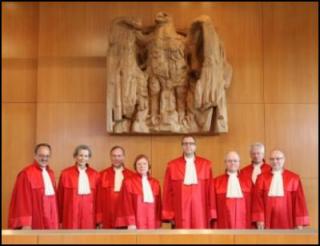 As we have seen from the recent ruling from the Supreme Court in Pinnock, British judges regard themselves as constrained to follow a “clear and consistent” line of authority from Strasbourg, even though the latter has no binding authority over the appellate courts in this country. Indeed, as we have noted in our post on the case, it overruled three of its own precedents without any ado.
How different the picture is in Germany, where the highest Constitutional Court, the Bundesverfassungsgericht, is armed with tremendous powers by the German Grundgesetz, or Basic Law, to uphold its own interpretation of national law in judgments that go to the heart of what the executive is or isn’t allowed to do.
Continue reading →
Like this:
Like Loading...
4 November 2010 by Adam Wagner
 Today marks the 60th anniversary of the signing of the European Convention on Human Rights on 4 November 1950. This comes hot on the heels of the tenth birthday of the Human Rights Act, which we celebrated on October 2nd.
The European Convention on Human Rights, which came into force on 3 September 1953, guarantees a range of political rights and freedoms of the individual against interference by the State. Before the incorporation of the Convention, individuals in the United Kingdom could only complain of unlawful interference with their Convention rights by lodging a petition with the European Commission of Human Rights in Strasbourg. That all changed on 2 October 2000 when the Human Rights Act 1998 came into force, allowing UK citizens to sue public bodies for breaches of their Convention rights in domestic courts.
Continue reading →
Like this:
Like Loading...
4 November 2010 by Adam Wagner
Updated | The dust has hardly settled on the government’s decision to allow prisoners to vote when, with uncanny timing, the European Court of Human Rights has denied the Austrian government permission to appeal in a similar case involving prisoners’ voting rights.
The Strasbourg court has notified Austria that its request for referral of the case of Frodl v Austria to the Grand Chamber has been rejected. This is likely to have a significant impact on the UK’s implementation of the prisoner voting system, as the court in Frodl effectively ruled that the disenfranchisement of prisoners could only happen on rare occasions: namely, where a prisoner was detained as a result of the abuse of a public position or a threat to undermine the rule of law or democratic foundations. As I said in Monday’s post:
Continue reading →
Like this:
Like Loading...
3 November 2010 by Adam Wagner
 Updated | Manchester City Council (Respondent) v Pinnock (Appellant) [2010] UKSC 45 On appeal from the Court of Appeal [2009] EWCA Civ 852 – Read judgment / press summary
The following is based on the Supreme Court press summary. Our full case comment is to follow.
The Supreme Court has ruled that Article 8 of the European Convention on Human Rights (the right to family life) requires that a court, when asked by a local authority to make an order for possession of a person’s home, must have the power to assess the proportionality of making the order.
The 9-strong court departed from a series of House of Lords (its predecessor’s) decisions in order to follow a strong line of European Court of Human Rights authority (summarised at para 45 of the decision). The judgment was unanimous, and follows the important recent decision of the European court in Kay and Others v United Kingdom (see our post), as well as that in Connors v UK and others. The decision represents a welcome clarification of the rights of council tenants facing eviction, following a long and tortuous line of conflicting decisions from both the UK and European courts.
Continue reading →
Like this:
Like Loading...
1 November 2010 by Adam Wagner
 Updated | According to the Daily Telegraph, the prime minister has conceded that the government has no choice but to comply with a five-year-old European Court of Human Rights judgment and grant prisoners voting rights in the next general election.
The Telegraph reports:
on Wednesday a representative for the Coalition will tell the Court of Appeal that the law will be changed following legal advice that the taxpayer could have to pay tens of millions of pounds in compensation.
The decision, which brings to an end six years of government attempts to avoid the issue, opens the possibility that even those facing life sentences for very serious crimes could in future shape Britain’s elections.
Continue reading →
Like this:
Like Loading...
1 November 2010 by Matthew Hill
 R v M(L) and others [2010] EWCA Crim 2327; [2010] WLR(D) 266 – Read judgment
The Court of Appeal (Criminal Division) has provided further guidance to prosecutors on whether or not they should bring charges against victims of human trafficking who go on to commit crimes. In the same judgment, the Court considered the extent of the obligation on the police to refer such victims to specialist agencies.
The state has a number of duties to victims of human trafficking deriving from the Council of Europe Convention on Action against Trafficking in Human Beings (CETS No 197).
Continue reading →
Like this:
Like Loading...
21 October 2010 by Rosalind English
 Radmacher (formerly Granatino) (Respondent) v Granatino (Appellant) [2010] UKSC 42 (On appeal from the Court of Appeal [2009] EWCA Civ 649) Read judgment
The Supreme Court has ruled that ante-nuptial arrangements should be binding and enforceable in ancillary proceedings. Thus in future it will be natural to infer that parties who enter into an ante-nuptial agreement to which English law is likely to be applied intend that effect should be given to it.
Although human rights were not in issue in this litigation, there is an interesting question to explore here in relation to the parties’ rights to peaceful enjoyment of their possession without interference by the state (in the form of a court order reversing the provisions of a private settlement). Now the Supreme Court has given nuptial agreements considerably more weight in the fall-out folllowing marital breakup the likelihood of a Convention-based challenge in this context falls away but does not disappear altogether because the statutory regime still obliges courts to interfere with agreements if they are considered unfair in any way, or prejudicial to the children of the marriage.
First, the following summary is based on the press release of the case published on the Supreme Court website.
Continue reading →
Like this:
Like Loading...
8 October 2010 by Rosalind English
 In his speech to the Conservative party conference, The foreign secretary William Hague has outlined the government’s plans for securing the sovereignty of parliament against the pressure of the European Union. He said:
A sovereignty clause on EU law will place on the statute book this eternal truth: what a sovereign parliament can do, a sovereign parliament can also undo … this clause will enshrine this key principle in the law of the land.
One commentator notes: “Tories plan fresh attacks on human and workers’ rights”. Another that there would be “subtle legal perils”.
Continue reading →
Like this:
Like Loading...
6 October 2010 by Adam Wagner
 Two prominent public law barristers spoke last night on the future of the Human Rights Act at the annual seminar organised by the Constitutional and Administrative Bar Association.
The seminar had a special significance as the HRA has just celebrated its 10th birthday. Both speakers looked to the future of the act in light of the coming budget cuts and economic austerity policies.
Continue reading →
Like this:
Like Loading...

 R (on the application of Zagorski and Baze) v Secretary of State for Business, Innovation and Skills and Archimedes Pharma UK Ltd – read judgment


Recent comments