Category: In the news
21 March 2011 by Adam Wagner
 Updated | The housing minister Grant Shapps wrote in yesterday’s Sunday Telegraph that he wants to make squatting a criminal offence and “shut the door to squatters once and for all”
The changes to the law are being investigated by the Ministry of Justice at the moment (update: read the government’s press release and new guidance here). They will be of interest from a human rights perspective, although aspects of the UK’s current approach to squatters rights were declared compatible with the European Convention on Human Rights by the grand chamber European Court of Human Rights in the 2007 case of JA Pye (Ocford) LTD v. United Kingdom.
What is interesting about the proposed clarifications and changes to the law is the way in which they were reported.
Continue reading →
Like this:
Like Loading...
20 March 2011 by Adam Wagner
 Updated | It all started with the reporting of an injunction, supposedly obtained by former Royal Bank of Scotland chief executive, “preventing him being identified as a banker”. A mildly interesting story, made marginally more so by the fact that the injunction had been breached by an MP during a Parliamentary debate.
But there is more to the story. As bloggers Anna Raccoon, Charon QC and Obiter J have reported, on a Parliamentary debate on Thursday the same Liberal Democrat MP, John Hemming, revealed the details of a number of other (what he called) “hyper” injunctions. The common feature was that courts had ordered not only that the parties to litigation were to be prevented from revealing details of their cases to the public, but also to their MPs.
Continue reading →
Like this:
Like Loading...
18 March 2011 by Adam Wagner
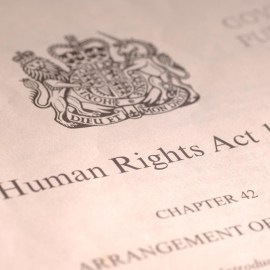 The much trumpeted commission on a UK Bill of Rights has been launched by the Ministry of Justice. It is pretty much as was leaked last week, although it will now have 8 rather than 6 experts chaired by Sir Leigh Lewis, a former Permanent Secretary to the Department of Work and Pensions.
The commission is to report by the end of 2012. Its members, described as “human rights experts”. Are they? The roll call, made up mostly of barristers, is:
Continue reading →
Like this:
Like Loading...
17 March 2011 by Adam Wagner

One of the country’s most senior judges, Lord Neuberger, has given a stirring speech on the challenges of open justice in the 21st century. His ideas are progressive and practical, and amount to a manifesto for building a more open justice system, fit for the internet age.
The annual Judicial Studies Board lecture has in recent years been used by the senior judiciary to criticise the European Court of Human Rights (see Lord Judge’s and Lord Hoffmann’s 2010 and 2009 speeches), so Neuberger’s Open Justice Unbound represents a refreshing change of pace.
Continue reading →
Like this:
Like Loading...
16 March 2011 by Rosalind English
 The government’s proposals for reform of the law on defamation have been published. The bill seeks to address concerns that libel law has a chilling effect on freedom of speech, failing to strike the right balance between free speech and protection of reputation.
The pressure of the widely-supported reform campaign, inspired by recent libel actions stifling comment on issues of scientific and academic debate, has no doubt contributed to the manifesto commitment on the part of all three parties which the coalition is now following through. The consultation paper and draft bill has been met with muted enthusiasm, with critics claiming that the proposed statute at best codifies the common law, with all its confusions and complexities, and that the whole is at worst “too little, too late” to meet their reform demands.
Continue reading →
Like this:
Like Loading...
16 March 2011 by Adam Wagner
 As well as blaming bloggers for media frenzies in yesterday’s Law in Action interview, the Attorney General also made some interesting comments on the UK’s bold new tactic on prisoner votes (see my post on Monday), which is effectively to try to appeal an unappealable ruling.
He said (from 19:20) that the UK “takes its responsibility seriously” and that it would be seeking to reform the court when it takes on the chairmanship later this year. “In any political process” he reminded Rozenberg, “the movement of the tectonic plates is always going to be a bit rough” (please note that the programme was recorded before the Japanese earthquakes). He would not say, however, whether the government would do anything to comply with the ruling in Hirst No. 2.
Continue reading →
Like this:
Like Loading...
16 March 2011 by Adam Wagner
 The Attorney General has warned publishers that the law may be changed to prevent them revealing the names of criminal suspects before they are charged. He also blamed the “massive” and “frenzied”coverage of pre-charge suspects in part on pressure on newspapers from the blogosphere.
Dominic Grieve told Joshua Rozenberg on yesterday’s Law in Action (listen here):
We seem to be living a world where because of competing interests on newspapers, perhaps in part because of the internet, because of the fact they are competing with the blogosphere where people are publishing a great deal of material, national newspapers are keen to give as much background detail to their readers as possible at early stages of criminal investigations. (09:25)
Continue reading →
Like this:
Like Loading...
14 March 2011 by Adam Wagner
 I recently compared the prisoner votes issue to a ping-pong ball in a wind tunnel. The latest twist in the saga is that the UK government is seeking to overturn the European Court of Human Rights’ ruling in Hirst No. 2. This is certainly a daring tactic, given that the ruling by the Grand Chamber is not open to appeal.
To set out the very basic background (again), in the 2005 decision of Hirst (No. 2),the Grand Chamber of the European Court held the UK’s blanket ban on prisoners voting is in breach of the electoral right under Article 1 of Protocol 3 of the European Convention on Human Rights. The court ruled that the ban was a “general, automatic and indiscriminate restriction on a vitally important Convention right“. Article 46 of the European Convention of Human Rights, which the UK signed up to, obliges it to “abide by the final judgment” of the European Court of Human Rights. So in theory, it should already complied with the judgment.
Continue reading →
Like this:
Like Loading...
14 March 2011 by Melina Padron
 It’s time for the human rights roundup, a regular bulletin of all the law we haven’t quite managed to feature in full blog posts. The full list of links, updated each day, can be found here.
by Melinda Padron
In the news
The government announced that a commission would be set up to look into whether the government should bring in a bill of rights in light of all the controversy surrounding the ECtHR. The commission is reported to be composed of experts such as Lord Lester, Helena Kennedy QC and Martin Howe QC, and its merits are already being called into question.
There have been two strong reminders of the importance of maintaining compliance with and membership to the European Court of Human Rights: Aidan O’Neill QC wrote an excellent piece questioning the legal merits of some of Dr Pinto-Duschnisky‘s proposals in his report Bringing Rights back home: making human rights compatible with parliamentary democracy in the UK; while Sir Konrad Schiemann, judge of the Court of Justice of the European Union, made a strong case that by abiding by its decisions, the UK would be serving the greater good of stability amongst its members.
Continue reading →
Like this:
Like Loading...
10 March 2011 by Adam Wagner
 Lord Anthony Lester, Helena Kennedy QC and Martin Howe QC are to sit on the upcoming commission on human rights reform, the press are reporting this morning.
Lester and Kennedy are both well-known human rights experts. Howe has long-standing proponent of replacing of the Human Rights Act with a bill of rights.
According to The Sun, which says the “probe on how to tackle power-crazy Euro judges is being held up by bickering Tories and Lib Dems“, the 7-strong commission will also include another Liberal Democrat nominee (in addition to Lester), two more members appointed by the Tories and a senior Ministry of Justice civil servant. It will have to report by December 2012.
Continue reading →
Like this:
Like Loading...
9 March 2011 by Guest Contributor
 At the end of the Wizard of Oz Dorothy manages to find her way back from the land of Oz to her farmstead in Kansas by closing her eyes, clicking the heels of her ruby-red slippers together, and repeatedly murmuring the incantation “There’s no place like home; there’s no place like home …”.
In his Bringing Rights back home: making human rights compatible with parliamentary democracy in the UK (Policy Exchange, 2011) the political scientist Dr. Michael Pinto-Duschinsky attempts a similar feat, seeking to bring human rights back from the Land of Stras(bourg).
Continue reading →
Like this:
Like Loading...
9 March 2011 by Adam Wagner
 Updated | CPS -v- Mohammad Razaul Haque and Emdadur Choudhury – Read judgment
A man has been found guilty of public order offences for burning poppies and chanting “British soldiers burn in hell” on Remembrance Day. He was fined £50.
The ruling, and in particular the fine, has led to public anger. The Sun called the fine “pathetic” and asked whether Britain is now “deep in a quicksand of political correctness and hand-wringing over human rights“. The Prime Minister has said that we should be “making a stronger statement that that sort of behaviour is completely out of order and has no place in a tolerant society”
The Sun is wrong that Emdadur Choudhury’s low fine had anything to do with human rights; Chief Magistrate Riddle made clear that “invoking the criminal law to interfere with freedom of expression is proportionate“. But two important questions do arise. First, whether the conviction represents a disproportionate breach of Emdadur Choudhury’s right to freedom of speech. Secondly, if the £50 fine was adequate.
Continue reading →
Like this:
Like Loading...
8 March 2011 by Rosalind English
 National Union of Rail, Maritime and Transport Workers v Serco (t/a Serco Docklands) [2011] EWCA Civ 226 – read judgment.
Aslef and RMT rail unions have succeeded in challenging injunctions that blocked their strike action over small faults in procedure.
The Court of Appeal has ruled that minor mistakes in balloting such as polling non-constituent workers – did not justify the injunctions that had prevented them from taking strike action. Trade union leaders have called the ruling a “major step for industrial freedom”.
Two strikes that were planned separately – by the RMT on London’s Docklands Light Railway and by Aslef on London Midland – were halted by injunctions in the High Court in December. The judge ruled that strike ballot procedures had not been properly followed and therefore the unions would be unlikely to claim the statutory protection for the action immunity under the Trade Union and Labour Relations (Consolidation) Act 1992 Pt V. The Court of Appeal has decided that ruling was wrong in law.
Continue reading →
Like this:
Like Loading...
7 March 2011 by Graeme Hall
 It’s time for the human rights roundup, a regular bulletin of all the law we haven’t quite managed to feature in full blog posts. The full list of links, updated each day, can be found here.
by Graeme Hall
In the news:
Although prisoner voting appears to have taken a back seat this week, the Daily Mail has reported that the UK government has asked the European Court of Human Rights to refer the decision of Greens and MT v UK to the Grand Chamber. This judgment gave compensation to two prisoners because the UK had failed to implement the court’s decision in Hirst v UK (No. 2). According to the article, the government wants to refer this decision to the court’s appeal chamber because the issue of prisoner voting rights has now been debated in Parliament. See our previous post on Greens and MT v UK, as well as our most recent summary of the ongoing prisoner voting issue. A BBC programme about the Strasbourg court can be accessed via the ECHR blog.
Continue reading →
Like this:
Like Loading...
7 March 2011 by Guest Contributor
 There probably aren’t many people who want to know what ‘goes on’ in the Court of Protection more than me; it’s what I spend much of my time trying to fathom. An outsider would be forgiven for thinking that this branch of Her Majesty’s Court Service doesn’t feel that case law in this tangled and difficult area is anybody’s business but it’s own.
The reasons for this appearance are complex though, and not necessarily the fault of any individuals working within the courts. I think it’s important to draw a distinction between different ways that greater ‘transparency’ could be achieved; some might be more helpful than others.
Continue reading →
Like this:
Like Loading...



Recent comments