By: Rosalind English
25 November 2010 by Rosalind English
 MA (Somalia) (Respondent) v Secretary of State for the Home Department (Appellant) [2010] UKSC 49. Read judgment
Update, 26 November – Rosalind English’s case comment is here
The following report is based on the press summary provided by the Supreme Court.
The issues raised in this appeal were: (1) the correct approach to the relevance of lies told by an asylum seeker in the assessment of real risk of persecution on return to his or her country of origin; and (2) how far it is legitimate for an appeal court to interfere with the assessment of facts made by a specialist tribunal on the grounds of error of law.
Continue reading →
24 November 2010 by Rosalind English
 Iraqis whose applications for asylum are unsuccessful will be continued to be deported, according to a government minister. The announcement comes despite the European Court of Human Rights effectively calling for a freeze on the practice.
The BBC reported on Monday that Foreign Office minister Alistair Burt told the them that Iraq was now considered safe enough for people to return to. An earlier post explored the legal implications of the return by the UK of Baghdad last year. The Upper Tribunal (Immigration and Asylum Chamber) held that the degree of indiscriminate violence in Iraq was not so high that the appellants could resist return.
Other parties, such as the UN High Commissioner for Refugees, maintain that much of Iraq remains unsafe, although the majority are sent to the North where explosions and shootings are not the danger they are in the South. But as long as the UK government maintain the view that Iraq is no longer a war-torn country, there are no grounds for the Iraqi’s continued presence in here.
Continue reading →
23 November 2010 by Rosalind English
 Updated | The recent High Court decision upholding the ban on electronic training collars for domestic animals raises the interesting and topical issue of animal welfare and its role in EU law.
In her post on the case Catriona Murdoch discusses the various arguments involved, from human rights to irrationality to proportionality under EU law, and the extent to which the language of human rights can be enlisted in the service of animal protection. Conor Gearty has analysed this topic in a persuasive paper published in 2008; here we look at the question in relation to permitted justifications for impeding free movement for goods and services in the Community.
Continue reading →
12 November 2010 by Rosalind English
 The much-debated “sovereignty clause” has now been published in the European Union Bill.
As predicted by our previous post on the subject and the wealth of commentary elsewhere, the declaratory provision does nothing more than set out, in unambiguous terms, the common law principle of parliamentary sovereignty; the principle that Parliament, being sovereign, cannot abandon its own sovereignty. It has no effect on the rights and obligations conferred by EU law. It simply serves as a reminder that the enforceability of these rights and obligations are dependent on the continuing survival of the European Communities Act 1972, and nothing more.
Continue reading →
10 November 2010 by Rosalind English

R v Chaytor and others (Appellants) UKSC 2010/0195 (Awaiting judgment)
The Supreme Court has dismissed the appellants’ appeal from the decision of the Court of Appeal Criminal Division that the Crown Court does have jurisdiction to try a Member of Parliament in relation to the submission of an allegedly dishonest claim for Parliamentary expenses or allowances.
The Appellants had argued that the court was deprived of jurisdiction by either or both of (i) Article 9 of the Bill of Rights 1688; or (ii) the exclusive jurisdiction of Parliament.
As can be seen from our previous posts on this matter, the appellants had each been committed for trial in the Crown Court on charges of false accounting contrary to s 17(1) Theft Act 1968 arising from their submission of claims for parliamentary expenses and/or allowances at a time when each appellant was a sitting Member of Parliament. At a preparatory hearing the appellants contended that the Crown Court did not have jurisdiction to determine the charges by reason of parliamentary privilege.
Read more:
10 November 2010 by Rosalind English
 Robert Elwyn Watkins v Philip James Woolas [2010] EWHC 2702 (QB) 5 November 2010- read judgment
Update – read our 3 December 2010 post on his defeat in the administrative court
The Election Court has ruled that the Labour MP for Oldham knowingly and deliberately misled the constituency and as a result his election is void under Section 106 of the Representation of the People Act (1983). Permission for judicial review of the decision has been refused.
The provision of the 1983 Act makes it an offence for anyone to publish “any false statement of fact in relation to the candidate’s personal character or conduct” to prevent them being elected “unless he can show that he had reasonable grounds for believing, and did believe, that statement to be true”.
Continue reading →
9 November 2010 by Rosalind English
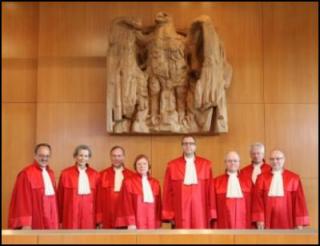 As we have seen from the recent ruling from the Supreme Court in Pinnock, British judges regard themselves as constrained to follow a “clear and consistent” line of authority from Strasbourg, even though the latter has no binding authority over the appellate courts in this country. Indeed, as we have noted in our post on the case, it overruled three of its own precedents without any ado.
How different the picture is in Germany, where the highest Constitutional Court, the Bundesverfassungsgericht, is armed with tremendous powers by the German Grundgesetz, or Basic Law, to uphold its own interpretation of national law in judgments that go to the heart of what the executive is or isn’t allowed to do.
Continue reading →
5 November 2010 by Rosalind English
 Updated | We posted earlier on the Supreme Court ruling in Manchester City Council (Respondent) v Pinnock (Appellant), that requires courts to be satisfied that any order for possession sought by local authorities must be “in accordance with the law”, and (ii) “necessary in a democratic society” – that is, that it should be proportionate in the full meaning of the word.
How far this takes us from the previous position, where the role of the county court was limited to conducting a conventional judicial review of the councils’ decision in such cases, remains to be seen.
Continue reading →
4 November 2010 by Rosalind English
 McLaughlin & Ors v London Borough of Lambeth & Anor [2010] EWHC 2726 (QB) – Read judgment
The High Court has been asked to consider whether the rule which prevents public authorities from suing in libel – to allow uninhibited criticism of government institutions – has the effect of preventing libel actions being taken by individual managers and employees of those institutions.
This was a claim by the defendants to strike out a libel action on grounds of abuse of process.The claimants are respectively head teacher, director of educational development and chairman of the governors of a primary school in Lambeth. The school was maintained by the first defendant pursuant to its statutory obligations. Now it is an Academy it is maintained by central government.
Continue reading →
28 October 2010 by Rosalind English
 Cadder (Appellant) v Her Majesty’s Advocate (Respondent) (Scotland) [2010] UKSC 43 Read judgment
We posted earlier on the Supreme Court’s ruling that an accused person’s rights under Article 6 of the Convention are breached if the prosecution leads and relies on evidence of the accused’s interview by police, if a solicitor was not present for that interview. Indeed Lord Hope thought it “remarkable” that
until quite recently, nobody thought that there was anything wrong with this procedure. Ever since ..1980, the system of criminal justice in Scotland has proceeded on the basis that admissions made by a detainee without access to legal advice during his detention are admissible. Countless cases have gone through the courts, and decades have passed, without any challenge having been made to that assumption.
Continue reading →
21 October 2010 by Rosalind English
 Radmacher (formerly Granatino) (Respondent) v Granatino (Appellant) [2010] UKSC 42 (On appeal from the Court of Appeal [2009] EWCA Civ 649) Read judgment
The Supreme Court has ruled that ante-nuptial arrangements should be binding and enforceable in ancillary proceedings. Thus in future it will be natural to infer that parties who enter into an ante-nuptial agreement to which English law is likely to be applied intend that effect should be given to it.
Although human rights were not in issue in this litigation, there is an interesting question to explore here in relation to the parties’ rights to peaceful enjoyment of their possession without interference by the state (in the form of a court order reversing the provisions of a private settlement). Now the Supreme Court has given nuptial agreements considerably more weight in the fall-out folllowing marital breakup the likelihood of a Convention-based challenge in this context falls away but does not disappear altogether because the statutory regime still obliges courts to interfere with agreements if they are considered unfair in any way, or prejudicial to the children of the marriage.
First, the following summary is based on the press release of the case published on the Supreme Court website.
Continue reading →
18 October 2010 by Rosalind English
 An injunction sought against the publication of certain information has been granted by the High Court in Northern Ireland under Article 2 (the right to life). The claimant also invoked the Prevention of Harassment (NI) Order and sought damages for misuse of private information. The Article 8 claim was only partially successful and the harassment claim was dismissed.
The claimant, who had been accused and subsequently cleared of murdering a journalist working for the defendant newspaper sought to prevent the publication of details relating to his address, his partner, his wedding plans and other personal information and photographs. The judge held that the publication of this information, in the light of threats from loyalist paramilitaries and dissident republican paramilitaries, would result in a “real and immediate risk” to the claimant’s life.
Continue reading →
15 October 2010 by Rosalind English
 Communications from an accountant giving legal advice do not attract legal professional privilege. The rule is only available if the advice is sought from a lawyer.
Notices under the Taxes Management Act 1970 (“Section 20 notices”) were served on the appellant company by the Revenue with a view to investigating a commercially marketed tax avoidance scheme. The appellant asserted that the notices required production of documents by which they sought or received legal advice on tax matters, in some cases from counsel and foreign lawyers, and in others from accountants.
Continue reading →
14 October 2010 by Rosalind English
 Full body scanners are to become the only security option for people flying out of Manchester Airport, the BBC reports today. The excessive amount of coverage given to the disapproval expressed by civil liberties groups has now been counterbalanced by passengers’ attitudes, since it appears that people actually prefer the scanners to the full body pat down, and have been voting with their feet.
According to Manchester Airport, 95% of travellers prefer the scanners and queuing times have been radically reduced. It takes 2 minutes to undergo a pat down, but a mere 27 seconds to pass through a scanner.
Continue reading →
8 October 2010 by Rosalind English
 In his speech to the Conservative party conference, The foreign secretary William Hague has outlined the government’s plans for securing the sovereignty of parliament against the pressure of the European Union. He said:
A sovereignty clause on EU law will place on the statute book this eternal truth: what a sovereign parliament can do, a sovereign parliament can also undo … this clause will enshrine this key principle in the law of the land.
One commentator notes: “Tories plan fresh attacks on human and workers’ rights”. Another that there would be “subtle legal perils”.
Continue reading →

 MA (Somalia) (Respondent) v Secretary of State for the Home Department (Appellant) [2010] UKSC 49. Read judgment


Recent comments